





Location
 Contact Us
 
Creation Model
Noah's Ark
Hyperbaric Biosphere
Creation In Symphony Videos Now Online
Watch the entire video series on our YouTube Channel
Noah's Ark Replica
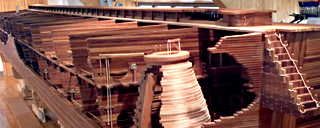
Dramatic 25 Foot Detailed Replica
Biosphere Project
Re-creating What It Was Like Before Noah's Flood
11
Apr

Creation Devotional March 14 - Biology

Daily Devotional – March 14

Biology


Electric eels are not eels but fish that live in the murky waters of South America. They can reach 6 feet long and weigh 45 pounds. All living things generate electrical charges in their cells. The electric eel has thousands of modified cells in its tail that are lined up like batteries in a flashlight. Each cell can generate only about 0.15 volts, but stacked together, the 6,000 cells make one giant battery that can generate as much as 600 volts. In comparison, a car battery generates 12 volts yet has enough power to start a large car engine.


Pure water is a very poor conductor of electricity, but the waters where electric eels live have enough salt and other minerals to make the water a good conductor. To shock their prey, electric eels bring their positive end, located in their head, close to the negative end, located in their tail. The electric shock is sent out from the positive end to the negative end of the “battery.” How did the eel know to trap its prey between its head and tail such that the electrical discharge would stun or kill its prey? Basic physics teaches that bringing two opposite electrical poles together concentrates the electric field. Evolutionists call eels “primitive creatures”, but creationists studying eels are not “shocked” by their level of sophistication. God created these creatures to glorify Him.


I will speak of the glorious honour of thy majesty, and of thy wondrous works.

- Psalm 145:5


Source: "Pearls in Paradise" by authors Bruce Malone and Jule Von Vett

References for this devotional.

11
Apr

Creation Devotional March 8 - Biology

Daily Devotional – March 8

Biology


Have you considered the bird called the whip-poor-will? I remember sleeping at Grandma’s and hearing the night music of the whip-poor-will putting me to sleep. This jay-sized bird makes its home where jack pine forests or oak savannas meet meadows and pastures. This nocturnal bird hunts mosquitoes, moths and beetles. On a moon-lit night, you might see it doing aerial stunts like banking, dipping, diving and hovering to catch its prey. It doesn’t build a nest but lays two eggs on the forest floor in fallen leaves. Both parents care for the young, making frequent hunting trips bringing back regurgitated bug porridge. They also exhibit one other fascinating characteristic - whip-poor-wills time their eggs to hatch exactly 10 days before the full moon. But why?


The bird chicks are at their hungriest about 10 days after hatching. Ten days after they come out of their eggs, the moon is at its brightest. Insects are the easiest to see and catch during a full moon. How did the first whip-poor-will come up with this idea? Did it have a calendar of when the full moon would appear, and then counted back 10 days for the hatching? A bird does not think about this; it comes about by instinct. The precise timing had to be preinstalled on the bird’s software, i.e. its brain. When we see such preinstalled software, we know there must be a software engineer. So, when you hear the night music of the whip-poor-will, think of the greatest software engineer, God.


The flowers appear on the earth; the time of the singing of birds is come, and the voice of the turtle is heard in our land;

~ Song of Solomon 2:12


Source: "Pearls in Paradise" by authors Bruce Malone and Jule Von Vett

References for this devotional.

11
Apr

Creation Devotional March 3 - Biology

Daily Devotional – March 3

Biology


Have you ever thought about how a honeybee communicates to the rest of the colony where the new source of nectar is? She does a dance! If the food source is near, she just dances in a circle. If the food source is over 100 yards away, she does the “waggle” dance, which is like a figure eight. The center of the “waggle” reveals the direction and distance to the flower. The bee uses the sun as a reference point to signal the direction to the flower from the hive. If the flower is toward the sun, the bee “waggles” up the vertical comb. If it is away from the sun, it “waggles” down the comb. If it is 60 degrees to the east of the sun, it will “waggle” at a 60 degree angle and so forth. The type of “waggle” is either fast or slow that communicates the distance and quality of the nectar. The dance is a complex but efficient form of communication.


Evolutionists believe that this dance came about slowly over a long period of time. Really? If only one bee came up with the idea and the others did not understand, the result would be no nectar gained. If this dance slowly evolved, how would all the bee ancestors have survived? If they survived without this complicated dance, why would they need to invent the dance? God programmed within the honeybee this unique form of communication. The honeybee’s communication style is so precise and complex that it shouts design! And God is that Designer!


O clap your hands, all ye people; shout unto God with the voice of triumph. For the Lord most high is terrible; he is a great King over all the earth.

~ Psalm 47:1-2


Source: "Pearls in Paradise" by authors Bruce Malone and Jule Von Vett

References for this devotional.

11
Apr

Creation Devotional March 2 - Biology

Daily Devotional – March 2

Biology


For thousands of years, the bee’s honeycomb has fascinated man. Pappus of Alexandria, a third-century A.D. astronomer and mathematician, was intrigued by the honeycomb shape found inside of hives. He asked himself, “Why is the honeycomb cell six-sided? Why isn’t the honeycomb cell a circle, triangle, or square?”


Pappus found that the six-sided shape, the hexagon, holds more honey and takes less wax to produce than any other shape. It was not until modern calculus was invented over a thousand years later that the shape of the cap at the end of the honeycomb cell was analyzed. Each cell cap is a pyramid made of three rhombuses. This cap shape was found to require the smallest possible amount of wax for construction. Each bee knows how to build this type of cell and cap. Some say they are great engineers; however, it is the One who designed the programming that controls the honeybee who is really the great engineer. That would be Jesus!


My son, eat thou honey, because it is good; and the honeycomb, which is sweet to thy taste:

~ Proverbs 24:13


Source: "Pearls in Paradise" by authors Bruce Malone and Jule Von Vett

References for this devotional.

20
Feb

Creation Devotional February 25 - Biology

Daily Devotional – February 25


Biology


Wouldn’t it be fun to walk right up the side of a wall or dash across the ceiling without tumbling to the floor? Only in comic books can fantasy heroes accomplish such feats. Inspiring such fiction are spiders, flies, and many other insects that have no trouble scurrying upside down across the ceiling. But no creature defies gravity like the gecko. Scientists have spent decades trying to discover how this heavy lizard, weighing hundreds of times more than an insect, can run upside down across surfaces as smooth as glass.


Originally, it was believed that tiny features on the gecko’s feet functioned like suction cups to suspend the lizard. Later, the real secret was discovered – hundreds of millions of microscopic hair-like filaments on the gecko’s feet exploit weak electrostatic attraction (van der Waal forces) that act as tiny magnets to hold the lizard to the ceiling1. But the mystery of how the gecko could turn these forces on and off to prevent its foot from remaining stuck to the ceiling remained.


More recent work has shown that the gecko hairs are curved like little bent hairs that can be snapped back and forth as the lizard moves across a surface allowing a rapid attachment/detachment mechanism to take place. Even researchers who believe in evolution describe the gecko with words like, “…amazing, finely balanced, and finely tuned this whole system is...” Mankind can invent imaginary wall-clinging heroes like Spiderman, but only God can create real creatures capable of displaying such amazing abilities.


The spider taketh hold with her hands, and is in kings’ palaces.

~ Proverbs 30:28


Source: "Pearls in Paradise" by authors Bruce Malone and Jule Von Vett

20
Feb

Creation Devotional February 20 - Biology

Daily Devotional – February 20


Biology


The dragon fish lives 1,500 to 4,500 feet below the surface of the ocean – it is what is known as a “deep-sea” animal. At that depth, light is minimal, and most deep-sea creatures can only see blue light because other wavelengths do not penetrate the ocean to such great depths.


In spite of this, the dragon fish can see red light because he has chlorophyll in his eyes. Yes, that’s right, chlorophyll - stuff that makes plants green. This chlorophyll allows the dragonfish to see in the red spectrum, giving the dragonfish a secret weapon. It pulses far red light which allows it to see its prey without itself being seen. You could say that a dragon fish’s eyes act like a night vision scope on a sniper’s rifle. How can evolution explain a dragon fish evolving chlorophyll, the stuff of green plants, within its eyes? And how did it know that this chlorophyll would help it to see in the red spectrum? And why would it evolve the ability to see in the red part of the light spectrum when it could not have known that red light even existed? Does anyone believe that a night vision sniper scope happened by accident and chance? The dragon fish’s sniper scope eyes bear witness to a powerful and unique designer, God Himself.


And the light shineth in darkness…

~ John 1:5a


Source: "Pearls in Paradise" by authors Bruce Malone and Jule Von Vett

20
Feb

Creation Devotional February 16 - Biology

Daily Devotional – February 16


Biology


Each fin on a fish is needed to move the fish. If the tail fin (caudal) was not there, the fish could not propel itself forward. If the pectoral fins and the pelvic fins were not present, the fish would not be able to steer. If the dorsal or anal fin was missing, the fish would not be able to stay upright and would tip sideways. All the fins are needed AND at the same time. Darwinian evolutionists believe that living organism developed and diversified from simple to complex during earth’s history. Yet, a fish with only two or three fins would not survive. All the fins, with their functions, were needed from the beginning in order for the fish to successfully swim.


Evolutionists believe that hundreds of millions of years ago fish evolved from some worm or sponge or other invertebrate. Not one single fossil has revealed this intermediate form of half-fish and half invertebrate. And as J.R. Norman, an evolutionist from the Department of Zoology, British Museum of Natural History, London, states, “The geological record has so far provided no evidence as to the origin of the fishes…” Fossils of invertebrates have been found, and fossils of fishes have been found, but nothing in-between! There are no transitional fossils showing the evolution of a fish. Scripture states that God created the swimming creatures, including fish, on Day 5 of the creation week. He created them as fully formed fish.


O Lord, our Lord, how excellent is thy name in all the earth!....

~ Psalm 8:1


Source: "Pearls in Paradise" by authors Bruce Malone and Jule Von Vett

20
Feb

Creation Devotional February 14 - Biology

Daily Devotional – February 14


Biology


A pig farmer in the UK heard an evolutionist academic talk about how the breeding of farm animals shows evolution. At the end of the lecture the pig farmer said, “Professor, I don’t understand what you are talking about. When I breedpigs, I get pigs—if it were not so I would be out of business!”


Evolutionists understand that the addition of new, increasingly complex information is required if a bacterium is to evolve into a man. For a reptile to change into a bird would require new genes to transform scales into feathers. The odds of random natural processes (like mutations) creating a new gene coding to make feathers (instead of reptilian scales) is essentially zero. Mutations always degrade the information found on the DNA molecule. Mutations never result in increasingly complex information. As ardent evolutionist Carl Sagan admitted: “… mutations occur at random and are almost uniformly harmful—it is rare that a precision machine is improved by a random change in the instructions for making it.” Rare indeed – and in most cases, NEVER!


There are many breeds of dogs, chickens, cats, and pigs, but they are all dogs, chickens, cats and pigs. The reshuffling of different genes produces the great variety within a kind, but the variety is limited to the genes that are present. If there are no genes for feathers, then feathers will not be present. Variation within a kind is not evolution! Galapagos finches are still finches, peppered moths are still peppered moths; they just show variety within a kind, not evolution. Things reproduce after their kind just as the Bible states. As the pig farmer said to the evolutionist, “I would be out of business if pigs did not produce pigs!”


And God said, Let the earth bring forth the living creature after his kind, cattle, and creeping thing, and beast of the earth after his kind:  and it was so.

~ Genesis 1:24


Source: "Pearls in Paradise" by authors Bruce Malone and Jule Von Vett

7
Feb

Creation Devotional February 11 - Biology

Daily Devotional – February 11


Biology


There is a small bird known as the “little dipper”, or water ouzel, that loves to dip into the water beside a fast-flowing river. This little bird flies, swims, and strolls along the bottom of the stream turning over rocks with his beak looking for food. He does not have webbed feet, so he uses his wings as oars to move through the water. He uses his air sacs to rise to the surface and compresses the air out of these sacs to submerge. The dipper’s eyes have a special lens curvature for underwater vision and nasal flaps in his nostrils that close when diving. After all, who wants water up one’s nose? Evolutionists will say this bird evolved. Why would he “evolve” all this underwater equipment when he could just as easily have gotten his food off the ground? Our heavenly Father just loves to show His creativity!


Hear, O ye kings; give ear, O ye princes; I, even I, will sing unto the Lord; I will sing praise to the Lord God of Israel.

~ Judges 5:3


Source: "Pearls in Paradise" by authors Bruce Malone and Jule Von Vett

7
Feb

Creation Devotional February 8 - Biology

Daily Devotional – February 8


Biology


Does a bumblebee have two or four wings? It has four wings. The wings are in pairs coupled together by a row of hooks on the back wing that grip in a groove on the rear edge of the front wing. As the bee gets ready to fly, its wings unfold causing the hooks to fall into the groove and lock in place. Now the wings are a single, large flight surface. A bumblebee can fly up, down, sideways, backwards and forwards, with a speed over 6 mph. The bee flaps its wings about 200 times a second, causing the buzzing noise we hear. Why is a bumblebee made with short wings? Watch it move around inside a flower to see the bee fold its wings and lay them along its back. Long wings would stick out and the bee would not be able to turn in tight spaces. The wings are specially designed. The way the bee’s wings couple together with hooks in a groove could not have come about by accident and chance; it was specifically designed for the work the bumblebee does.


If I take the wings of the morning,…

~ Psalm 139:9


Source: "Pearls in Paradise" by authors Bruce Malone and Jule Von Vett

ABOUT THE MUSEUM
The Creation Evidence Museum
of Texas is a 501(c)3 non-profit
educational museum chartered
in Texas in 1984 for the purpose
of researching and displaying
scientific evidence for creation.
CONTACT INFO.

3102 FM 205
Glen Rose, Texas 76043
Phone: 254-897-3200

Map Pin   Location Map

HOURS

Thursday - Saturday
10am - 4pm

ADMISSION

$5 Per Person
FREE - Children 5 & Under

Creation Evidence Museum Building

Use & Privacy Policy  |  Site Map

All contents © 2013 Creation Evidence Museum of Texas. All rights reserved. Please note that any use of content downloaded or printed from this site is limited to
non-commercial personal or educational use, including "fair use" as defined by U.S. copyright laws.