






Location
 Contact Us
 
Creation Model
Noah's Ark
Hyperbaric Biosphere
Creation In Symphony Videos Now Online
Watch the entire video series on our YouTube Channel
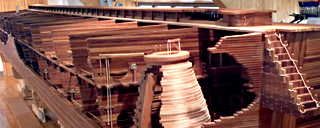
Noah's Ark Replica
Dramatic 25 Foot Detailed Replica
Biosphere Project
Re-creating What It Was Like Before Noah's Flood
7
Feb

Creation Devotional February 6 - Biology

Daily Devotional – February 6


Biology


Marine loggerhead turtles are found in all of the world’s oceans with the exception of the Arctic. They have the longest known migration route of any marine animal. For example, a little hatchling on the coast of Japan swims to its feeding area along the coast of California and back to the exact beach where it was hatched each year. Over its lifetime, it will migrate millions of miles!


It has been known for decades that loggerheads have a built-in “compass” in their heads that allow them to know their latitude; the equator is 0 degrees while the north or south pole is 90 degrees. When traveling north to south, the magnetic field will vary in intensity. Recently scientists were amazed to find that loggerheads can also detect longitude, traveling east or west. Longitude is very difficult to discern because earth’s magnetic field does not vary much east to west; only the angle of the magnetic pull changes and only to a very minute degree. Loggerheads were found to have not just a “compass” but a built-in “GPS” system detecting both the intensity and angle of the magnetic field. It took humans hundreds of years and a great deal of money to build instruments measuring longitude. Does ANYONE believe mankind’s GPS systems happened by accident and chance? Loggerheads have astounding migration abilities by using their GPS. And who is their GPS Maker? God Himself.


All thy works shall praise thee, O Lord….

~Psalm 145: 10


Source: "Pearls in Paradise" by authors Bruce Malone and Jule Von Vett

7
Feb

Creation Devotional February 4 - Biology

Daily Devotional – February 4


Biology


Have you ever noticed how the colors on a butterfly or moth wing seem to change and almost glow as it flies through the air? Pilots flying above the rainforests in South America have reported seeing the bright blues of the morpho butterfly up to half a mile away! What makes the butterfly wing so vibrant and colorful? Butterfly wings are covered with two or three layers of microscopic scales separated by air. Light passing through these layers is scattered, and depending on the angle of view, the light waves recombine in different combinations of different wavelengths. This is called diffraction, which produces iridescence. The multiple layers of scales on a butterfly wing create these intensely shifting color hues.


The scales of butterfly wings are made of very thin layers of a hardened protein called chitin. Your hair and nails are made of this same protein. These scales protect and insulate the insects and aid in the flow of air along their wings. The scales also help the butterfly absorb heat. Since butterflies are cold-blooded, they rely on external sources of heat.


But where did the butterfly’s beauty and complexity come from? Neither the beauty nor the structure of the butterfly wing has ever been explained by evolution. Those who reject creation throw the word “evolution” at such complex creatures and assume that just using the word explains how they developed. To produce these iridescent colors requires complex optical physics and mathematics. Could this phenomenon of iridescence happen by accident and chance? Caterpillars are not made of chitin scales, but butterflies are, so how would the caterpillar develop this characteristic slowly and randomly over time in order to become a butterfly? If evolution were true, we should first find a butterfly without chitin scales and then a butterfly with chitin scales. We find nothing like this in the fossil record. The oldest butterfly and moth fossils are fully formed and developed, looking essentially identical to current moths and butterflies.


Butterflies, with their beauty and complexity, proclaim there is a God!


Let them praise the name of the Lord: for his name alone is excellent; his glory is above the earth and heaven.

~ Psalm 148:13


Source: "Pearls in Paradise" by authors Bruce Malone and Jule Von Vett

7
Feb

Creation Devotional February 3 - Biology

Daily Devotional – February 3


Biology


The giant silk moth can have a wing area of over 60 square inches with a tail over 8 inches long. Cleaning this insect off your windshield just might empty your washer fluid! Yet every portion of the wings and tail is covered with intricately-designed scales, which produce beautiful iridescent patterns. But why are they so beautiful? The Christian perspective is that their beauty reflects the character of their Maker. The evolutionary perspective is that they are simply a product of chance. Which perspective is correct?


Those working to explain all of life without God make up stories to explain why butterflies are so beautiful. They say the gorgeous colors exist to draw mates or camouflage the insects from predators. Yet the brilliant coloration does the opposite of hiding the insects. The 1500 known species of the giant silk moth fly only at night when the brilliant coloration cannot be seen. Why would a moth with “eyespots” need these spots when it only comes out at night?


Butterflies and moths confound those who wish to believe God does not exist. Not only do both kinds of flying insects transform themselves from a leaf-chewing, land-bound caterpillar into a nectar-sucking, flying wonder, but each can be breathtaking in its beauty. Neither the origin of this flying insect, nor the explanation for its beauty, can be explained by evolution; it is only by looking at God that we find the answer. He is the master Creator of beauty – all-knowing and all-powerful!


He hath made everything beautiful in his time….

~ Ecclesiastes 3:11


Source: "Pearls in Paradise" by authors Bruce Malone and Jule Von Vett

21
Jan

Creation Devotional January 24 - Biology

Daily Devotional - January 24


Biology


Have you considered how a one-humped dromedary camel survives a harsh, hot, dry climate? The camel’s hump is like a fatty backpack - not a hollow water storage reservoir. This fat is actually food stored for


later use. When food is not available, nourishment is provided by the stored fat in the hump. When nourishment is taken out of the hump and not replenished over a long period of time, the hump actually shrinks and flops over. When food becomes more plentiful, the hump swells to become a fatty backpack again.


Most mammals distribute fat all over their bodies (including humans – much to our displeasure)! However, fat is a great insulator, and if camels stored fat all over their bodies, the heat would be held in - not a desirable design in extremely hot desert climates. A camel’s design allows it to store energy for future use without becoming overheated. In addition, the design of the camel’s hump protects the vital organs below from the heat of the sun beating down on the topside of the camel. Dromedaries thrive in extremely hot, dry climates because of this ingenious fat storage design. How would a camel know it needed to store the fat in one place and not over all its body? How would it get all its fat cells together in one place in its hump? Dromedaries are wonderfully designed to live in hot, dry deserts, and their hump is just one of many parts which testify to the genius of their Creator.


Cast thy burden upon the Lord, and he shall sustain thee:  he shall never suffer the righteous to be moved.

~ Psalm 55:22


Source: "Pearls in Paradise" by authors Bruce Malone and Jule Von Vett

21
Jan

Creation Devotional January 21 - Biology

Daily Devotional - January 21


Biology


Orcas, commonly called “killer whales”, are neither whales nor killers of humans. Orcas are the largest mammal of the dolphin family and have a unique herding method more in common with sheepdogs than ocean creatures.


When a pod of orcas find a school of herring, they start a coordinated, circular swimming pattern in order to corral the fish into a tight ball and force them to the surface. The orcas work as a well-orchestrated team to herd the fish upward, using bubbles, clicking calls, flashing their white underside to frighten the fish, and swinging their tails to keep any fish from escaping. The herring become so tightly packed that the surface of the ocean containing the herring ball looks like it is literally boiling. According to cetacean biologist Tiu Simila, “It’s like a ballet, so they have to move in a very coordinated way; and communicate, and make decisions about what to do next.”


While some of the orcas continue to keep the school of fish corralled, others in the pod take turns slapping the underwater ball of herring with their tails, resulting in a few stunned fish dropping out of the school. The herring normally move far too fast for orcas to catch, but by working as a team, the Orcas can take turns eating the stunned fish, one by one.


How can we explain such sophisticated behavior? Believers in naturalism credit it to “evolution” - as if the mere mention of the word explains such complex behavior. Yet, the use of a word actually explains nothing. Such complex, instinctual behaviors have never been explained by evolution. Such coordinated hunting methods are only useful once they exist. So how could pre-orca dolphins, not possessing such behavior, have learned to act in such a coordinated method? If they couldn’t do it from the beginning, they would go hungry!


God created all creatures with the ability to survive and thrive. It is this complex instinctual behavior that shouts “DESIGN.”


[He] doeth great things past finding out; yea, and wonders without number.
~ Job 9:10


Source: "Pearls in Paradise" by authors Bruce Malone and Jule Von Vett

21
Jan

Creation Devotional January 17 - Biology

Daily Devotional - January 17


Biology


How do fish swim in murky water or schools without running into each other? It’s the fish’s lateral line. On either side of the fish, running from the gills to the tail, is a line of small pores that are filled with hairs (neuromasts). These sensory hairs pick up very tiny vibrations and pressure changes traveling through the water and convert them to electrical impulses that are sent to the brain. With a line of many hair clusters (neuromasts) picking up information at different points on the lateral line, the fish has the ability to figure out what is happening around it.

Scientists have successfully copied the fish’s lateral line and hope to install them on submersibles and other underwater vehicles. These scientists used great engineering skills to develop this new technology. It would be an insult to their intelligence to say their artificial lateral line happened by accident and chance. Then why would we say the fish’s lateral line happened by accident and chance? It was created by the Great Engineer Himself, God. So the next time you pick up a fish, look for the lateral line (on some fish it is hard to see) and praise the Great Engineer for His great design.


Or speak to the earth, and it shall teach thee: and the fishes of the sea shall declare unto thee. Who knoweth not in all these that the hand of the Lord hath wrought this?

~ Job 12:8-9


Source: "Pearls in Paradise" by authors Bruce Malone and Jule Von Vett

21
Jan

Creation Devotional January 15 - Biology

Daily Devotional - January 15


Biology


Did platypuses evolve in Australia? There are two monotremes (mammals that lay eggs) in Australia - the platypus and the echidna. These animals have all the normal characteristics of mammals (backbone, hair, milk glands), yet they lay eggs instead of giving birth to live young. We only find platypuses and echidnas in Australia. So how did they get there?


Noah took two of each kind on the Ark, which landed in the Middle East (Mt. Ararat). Echidnas and platypuses spread out to various parts of the world, yet it seems they only survived in Australia. During the Ice Age, the interior of Australia would have been well-watered and very lush, allowing the platypus and echidna to spread out and fill Australia. Only after the Ice Age ended did the enormously dry Australian desert areas develop. When the sea levels rose at the end of the Ice Age, Australia was cut off from Asia, isolating its unique animal life on this very big island.


Did platypuses evolve? Fossil platypuses are essentially identical to modern platypuses; no transitional forms have been found. The Bible says God created fully formed land animals on Day 6 of Creation week. When we look with our “biblical” glasses, we can understand why platypuses are found in Australia.


Bring forth with thee every living thing that is with thee, of all flesh, both of fowl, and of cattle, and of every creeping thing that creepeth upon the earth; that they may breed abundantly in the earth, and be fruitful, and multiply upon the earth.

~ Genesis 8:17


Source: "Pearls in Paradise" by authors Bruce Malone and Jule Von Vett

8
Jan

Creation Devotional January 7 - Biology

Daily Devotional - January 7

Biology


Have you heard of “buzz pollination”? About 8% of flowering plants have their pollen so tightly locked away that most pollinating insects cannot reach it. With these flowers, only a loud sound of a certain frequency will release a shower of pollen.

The Virginia Meadow Beauty is one of these flowers; it will not release its pollen unless “buzzed” by a bumblebee. A honeybee can crawl around the flower all day and never get any pollen. Only the correct buzzing sound releases the pollen! In America, bumblebees are required for proper tomato flower pollination. These bumblebees make a buzzing sound at exactly middle C (261.63 Hz). No other frequency causes the pollen to be released from the tomato flower! Honeybees work in silence; therefore, no pollen is released for them. Dr. Sarah Smith Greenleaf demonstrated this process using a tuning fork. When she struck a middle C and placed the tuning fork near the tomato flower, a cloud of yellow pollen appeared. Only bumblebees buzz at the correct frequency to unlock the pollen.

How did buzz pollination come about? What advantage would this be for the flower - to lock pollen from a pollinator? Why would the bumblebee develop the right frequency to unlock the pollen when he could get pollen from other plants that do not require buzz unlocking? We are observing design in this process, and God is that Designer.


All things were made by him; and without him was not anything made that was made.

~ John 1:3


Source: "Pearls in Paradise" by authors Bruce Malone and Jule Von Vett

8
Jan

Creation Devotional January 5 - Biology

January 5

Biology


What ant-sized crustacean resembles a bright iridescent blue jewel but disappears in the blink of an eye? It is the sea sapphire, which lives in tropical and subtropical oceans around the world. This amazing creature can appear and disappear before our very eyes because of the cell structure on its back. A sea sapphire has microscopic layers of honeycomb-shaped crystal plates embedded in its skin cells. The crystal plates are all the same thickness, but the spacing between the stack of plates determines the wavelength of light (color) that is reflected back. The space between these plates is four ten-thousandths of a millimeter, about the same distance as a wavelength of blue light, so blue light is reflected back. If the angle of viewing changes to 45 degrees, the reflected light shifts from the visible light range to the invisible ultra-violet range, making it disappear before our very eyes. How intricate and precise! Our Creator loves to delight us with the smallest details - even beautiful, disappearing crustaceans aptly named sea sapphires.


And above the firmament that was over their heads was the likeness of a throne, as the appearance of a sapphire stone

~ Ezekiel 1:26


Source: "Pearls in Paradise" by authors Bruce Malone and Jule Von Vett

ABOUT THE MUSEUM
The Creation Evidence Museum
of Texas is a 501(c)3 non-profit
educational museum chartered
in Texas in 1984 for the purpose
of researching and displaying
scientific evidence for creation.
CONTACT INFO.

3102 FM 205
Glen Rose, Texas 76043
Phone: 254-897-3200

Map Pin   Location Map

HOURS

Thursday - Saturday
10am - 4pm

ADMISSION

$5 Per Person
FREE - Children 5 & Under

Creation Evidence Museum Building

Use & Privacy Policy  |  Site Map

All contents © 2013 Creation Evidence Museum of Texas. All rights reserved. Please note that any use of content downloaded or printed from this site is limited to
non-commercial personal or educational use, including "fair use" as defined by U.S. copyright laws.