Location
 Contact Us
 
Creation Model
Noah's Ark
Hyperbaric Biosphere
Creation In Symphony Videos Now Online
Watch the entire video series on our YouTube Channel
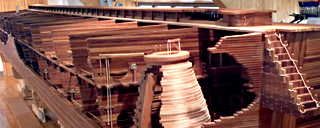
Noah's Ark Replica
Dramatic 25 Foot Detailed Replica
Biosphere Project
Re-creating What It Was Like Before Noah's Flood
11
Apr

Creation Devotional March 3 - Biology

Daily Devotional – March 3

Biology


Have you ever thought about how a honeybee communicates to the rest of the colony where the new source of nectar is? She does a dance! If the food source is near, she just dances in a circle. If the food source is over 100 yards away, she does the “waggle” dance, which is like a figure eight. The center of the “waggle” reveals the direction and distance to the flower. The bee uses the sun as a reference point to signal the direction to the flower from the hive. If the flower is toward the sun, the bee “waggles” up the vertical comb. If it is away from the sun, it “waggles” down the comb. If it is 60 degrees to the east of the sun, it will “waggle” at a 60 degree angle and so forth. The type of “waggle” is either fast or slow that communicates the distance and quality of the nectar. The dance is a complex but efficient form of communication.


Evolutionists believe that this dance came about slowly over a long period of time. Really? If only one bee came up with the idea and the others did not understand, the result would be no nectar gained. If this dance slowly evolved, how would all the bee ancestors have survived? If they survived without this complicated dance, why would they need to invent the dance? God programmed within the honeybee this unique form of communication. The honeybee’s communication style is so precise and complex that it shouts design! And God is that Designer!


O clap your hands, all ye people; shout unto God with the voice of triumph. For the Lord most high is terrible; he is a great King over all the earth.

~ Psalm 47:1-2


Source: "Pearls in Paradise" by authors Bruce Malone and Jule Von Vett

References for this devotional.

11
Apr

Creation Devotional March 2 - Biology

Daily Devotional – March 2

Biology


For thousands of years, the bee’s honeycomb has fascinated man. Pappus of Alexandria, a third-century A.D. astronomer and mathematician, was intrigued by the honeycomb shape found inside of hives. He asked himself, “Why is the honeycomb cell six-sided? Why isn’t the honeycomb cell a circle, triangle, or square?”


Pappus found that the six-sided shape, the hexagon, holds more honey and takes less wax to produce than any other shape. It was not until modern calculus was invented over a thousand years later that the shape of the cap at the end of the honeycomb cell was analyzed. Each cell cap is a pyramid made of three rhombuses. This cap shape was found to require the smallest possible amount of wax for construction. Each bee knows how to build this type of cell and cap. Some say they are great engineers; however, it is the One who designed the programming that controls the honeybee who is really the great engineer. That would be Jesus!


My son, eat thou honey, because it is good; and the honeycomb, which is sweet to thy taste:

~ Proverbs 24:13


Source: "Pearls in Paradise" by authors Bruce Malone and Jule Von Vett

References for this devotional.

11
Apr

Creation Devotional March 1 - Christian Truth

Daily Devotional – March 1

Christian Truth


Why spend time talking about the evidence for creation, aren’t we, “justified by faith?” (Romans 5:1)


Romans 1:19-20 states that all people are without excuse for lack of belief in God because all people can clearly see what He has made by observing the creation. The world is filled with people who can see the intricacies and design of life and the vast scale of the universe – but are still blinded to the reality of God’s existence. Therefore, more than physical evidence is needed to convince people that God exists, that He has died for our sins, and that we must accept His sacrifice for our sins to come back into fellowship with Him. Mature Christians understand that this awakening to the truth is the working of the Holy Spirit within people’s lives, but hearing the evidence from creation opens people’s spiritual eyes. Immature Christians absolve themselves of any responsibility to do anything to reach others with this truth by assuming that it is the Holy Spirit’s job to reach people and that people have been given the freedom to reject the obvious (if they choose to).


God has always used people to reach other people. Yes, all the credit for a person’s spiritual eyes being opened goes to God, but He commands us to be the ones who place the truth in front of others. He has always used people to reach other people with the truth. The greatest teacher, Jesus Christ, was both fully man and fully God. Thus God Himself became a man to reach other men with the truth. We MUST explain to others that God is the Creator and evolution is just a story. Christians need to get out of the bleachers and into the game and speak of God the designer/Creator/Redeemer.


How beautiful are the feet of them that preach the gospel of peace, and bring glad tidings of good things!

~ Romans 10:15b


Source: "Pearls in Paradise" by authors Bruce Malone and Jule Von Vett

References for this devotional.

8
Jan

Creation Devotional January 7 - Biology

Daily Devotional - January 7

Biology


Have you heard of “buzz pollination”? About 8% of flowering plants have their pollen so tightly locked away that most pollinating insects cannot reach it. With these flowers, only a loud sound of a certain frequency will release a shower of pollen.

The Virginia Meadow Beauty is one of these flowers; it will not release its pollen unless “buzzed” by a bumblebee. A honeybee can crawl around the flower all day and never get any pollen. Only the correct buzzing sound releases the pollen! In America, bumblebees are required for proper tomato flower pollination. These bumblebees make a buzzing sound at exactly middle C (261.63 Hz). No other frequency causes the pollen to be released from the tomato flower! Honeybees work in silence; therefore, no pollen is released for them. Dr. Sarah Smith Greenleaf demonstrated this process using a tuning fork. When she struck a middle C and placed the tuning fork near the tomato flower, a cloud of yellow pollen appeared. Only bumblebees buzz at the correct frequency to unlock the pollen.

How did buzz pollination come about? What advantage would this be for the flower - to lock pollen from a pollinator? Why would the bumblebee develop the right frequency to unlock the pollen when he could get pollen from other plants that do not require buzz unlocking? We are observing design in this process, and God is that Designer.


All things were made by him; and without him was not anything made that was made.

~ John 1:3


Source: "Pearls in Paradise" by authors Bruce Malone and Jule Von Vett

8
Jan

Creation Devotional January 6 - Cosmology

Daily Devotional - January 6

Cosmology


Under the inspiration of the Holy Spirit, Jeremiah compared the future descendants of Israel, “… as countless as the stars of the sky and as measureless as the sand on the seashore” (Jeremiah 33:22). Jeremiah was explaining that Jews would become so widely dispersed around the earth that no census could count them, just as all the stars in the universe or grains of sand upon the earth could never be counted. Yet in his day, all the visible stars could be counted. At that time, 600 B.C., early astronomers counted about 3,000 stars in the night sky. It was not until the 20th century that astronomy affirmed that the stars were indeed countless by humans.


The Hubble telescope captured a long time-lapsed image in a seemingly dark part of the universe near the Big Dipper. The area they photographed would be equivalent to our standing on earth and holding a grain of sand at arm’s length. When this image was compiled, this completely dark region was found to contain more than 10,000 galaxies, with each galaxy containing an estimated 100 billion stars (Hubble Ultra-Deep Field). Now imagine grains of sand covering the night sky and behind each grain being more than 10,000 galaxies, each containing 100 billion stars! What an immense number of stars. Truly the numbers of stars are as countless as the sands on the seashore! Our minds can hardly grasp the multitude of stars! Today it is estimated that there are roughly 1024 (10 followed by 24 zeros) stars. And the Jewish descendants are indeed scattered around the globe in numbers so large that no census can count them all. When God speaks on science, what he has to say is absolutely accurate. Should that be any surprise? After all, He’s the one who made science!


The heavens declare the Glory of God.

~ Psalm 19:1a


Source: "Pearls in Paradise" by authors Bruce Malone and Jule Von Vett

8
Jan

Creation Devotional January 5 - Biology

January 5

Biology


What ant-sized crustacean resembles a bright iridescent blue jewel but disappears in the blink of an eye? It is the sea sapphire, which lives in tropical and subtropical oceans around the world. This amazing creature can appear and disappear before our very eyes because of the cell structure on its back. A sea sapphire has microscopic layers of honeycomb-shaped crystal plates embedded in its skin cells. The crystal plates are all the same thickness, but the spacing between the stack of plates determines the wavelength of light (color) that is reflected back. The space between these plates is four ten-thousandths of a millimeter, about the same distance as a wavelength of blue light, so blue light is reflected back. If the angle of viewing changes to 45 degrees, the reflected light shifts from the visible light range to the invisible ultra-violet range, making it disappear before our very eyes. How intricate and precise! Our Creator loves to delight us with the smallest details - even beautiful, disappearing crustaceans aptly named sea sapphires.


And above the firmament that was over their heads was the likeness of a throne, as the appearance of a sapphire stone

~ Ezekiel 1:26


Source: "Pearls in Paradise" by authors Bruce Malone and Jule Von Vett

8
Jan

Creation Devotional January 4 - History

Daily Devotional - January 4

History


When we hear the word “cavemen,” we often think of primitive people wearing bear skin clothing and carrying wooden clubs. In fact, people have lived in caves throughout history; some even live in caves today. In the Yellow River region of China, some 20 million people are still living in caves. These caves are carved out of silty soil and are packed so hard that they do not need support. The caves usually measure 10 feet by 13 feet and extend 20 to 25 feet into the hillside. They are warm in the winter and cool during the hot summer. They have many modern comforts such as plumbing, electricity, and even cable television. Caves are a great place to live, to which 20 million Chinese can attest. Are these people primitive? Hardly! Based purely on evolutionary ideas, people assume that humans who lived in caves were primitive brutes. In chapter 10 of Genesis we find the account of the tower of Babel. As people migrated across the earth, some sought shelter in caves as they built more permanent homes. Today we often find their archeological remains in caves. Neanderthal man is one such example. The fact that they lived in caves did not make them primitive; it is just another housing choice.


Then he came there to a cave and lodged there…

~ 1 Kings 19:9


Source: "Pearls in Paradise" by authors Bruce Malone and Jule Von Vett

2
Mar

Creation Lesson #8 - Creativity of Man, Mind of Man, Noah’s Ark, Gutenberg Press


Introduction


At the Creation Evidence Museum an entire section is dedicated to displays featuring the “Creativity of Man.” It begins with the construction of the 25-foot Replica by Dale Muska and his assistants; it continues with the creativity displayed in the engineering of the 1904 Oldsmobile, the artistry in the clay statue of coach Tom Landry by artist Robert Summers, the speech employed by Chief American Horse (featuring the actual attire he wore while negotiating peace between the Red Man and the White Man after the Battle of Little Big Horn), and the design in the space exploration instruments constructed by aerospace engineer Robert Helfinstine and his associates. These displays are actually in place at the museum. We should also mention the invention of the Gutenberg Press with movable type. The first book to be printed was the Gutenberg Bible! (The premier replicator of the Gutenberg Press is currently building a full-scale replica for our museum).


I.  The Unparalleled Mind of Man


At the heart of the creativity of man is his awesome mind, designed to reflect the image of the Creator Himself. The human brain’s three pounds represent a mere two percent of the body weight…the quartful of brain is so metabolically active that it uses twenty percent of the oxygen we take in through our lungs…A third of our genes code for one or another aspect of the brain.”[1]


The brain allows the finger to feel vibrations of 8/1000 of an inch…Allows the eye to see 10 million different colors.[2] [T]he brain’s complexity is beyond anything [we had] imagined…the total number of synapses in a brain roughly equal the number of stars in 1,500 Milky Way galaxies![3] At the subconscious level “people can actually reason, anticipate consequences, and devise plans – all without knowing they are doing so.”[4] This introduces us to the power of the human mind and its amazing creativity.


Scientific American reports: “ [M]ounting evidence indicates that…a large mental gap separates us from our fellow creatures.”[5] “[O]ur species alone creates soufflés, computers, guns, make-up, plays, operas, sculptures, equations, laws and religion. Not only have bees and baboons never made a soufflé, they have never even contemplated the possibility.”[6]


The author lists various intriguing feats that animals accomplish and explains that “animal thoughts are largely anchored in sensory and perceptual experiencesWe alone ponder the likes of unicorns, and aliens, nouns and verbs, infinity and God.”[7] The same article lists four unique ingredients of the human mind. (1) Generative computation enables humans to create a virtually limitless variety of words, concepts and things. (2) Promiscuous combination of ideas allows the mingling of different domains of knowledge – such as art,…space, causality and friendship – thereby generating new laws, social relationships and technologies. (3) Mental symbols encode sensory experiences both real and imagined, forming the basis of a rich and complex system of communication. (4) Abstract thought permits contemplation of things beyond what we can see, hear, taste or smell.”[8]


II.  The Ark of Noah


Our 25-foot (1/20 scale) Replica of the Ark is the culmination of over forty years of research, months of working with our draftsman, eighteen months of actual craftsmanship on the vessel itself, and the sacrifice of dear people who contributed to make it possible.   The original Ark was 300 cubits long, 50 cubits wide, and 30 cubits high[9]. The cubit is normally considered to be about 18 inches in length. Often the ”royal cubit” was given as up to 26 inches. Our research indicates that the cubit was very close to 20.5 inches. This would make the original Ark 500 feet long, 86 feet wide, and 52 feet high.


III.  The Gutenberg Press


The art of printing originated in China. Emperor Ling of the Eastern Han dynasty inadvertently inspired this invention in AD 175 when he commanded that Confucian classics be engraved in stone. Bi Sheng invented a form of movable print during the reign of the Emperor Renzong of the Song dynasty, between AD 1041 and AD 1048. He took thin pieces of clay mixed with a sticky substance, carved a mirror image Chinese character on each piece and baked it in a kiln. When printing, he placed the characters in proper order on a coated metal plate.


Johannes Gutenberg (c.1395 – 1468) was a German blacksmith, goldsmith, printer, and publisher who introduced printing to Europe. His invention of mechanical movable type printing played a key role in the development of the Renaissance, Reformation, the Age of Enlightenment, and the Scientific Revolution and laid the material basis for the modern knowledge-based economy and the spread of learning to the masses. Gutenberg was the first European to use movable type printing, around 1439. Among his many contributions to printing are: the invention of a process for mass-producing movable type; the use of oil-based ink; and the use of a wooden printing press similar to the agricultural screw presses of the period. His truly epochal invention was the combination of these elements into a practical system which allowed the mass production of printed books. In Renaissance Europe, the arrival of mechanical movable type printing introduced the era of mass communication which permanently altered the structure of society.[10]


[1] Sherwin B. Nuland, op cit, p. 328

[2] Paul A. Bartz, Letting God Create Your Day (Minneapolis: Bible Science Association, 1993) Vol.4, p. 197

[3] E.A. Moore, Human Brain has more switches than all computers on Earth, CNET News, news.cnet.com November 17, 2010

[4] Joseph Weiss, “Unconscious Mental Functioning,” Scientific American, March 1990, p. 103

[5] Marc Hauser, “The Mind,” Scientific American, September 2009, p. 44

[6] Ibid.

[7] Ibid., p. 46

[8] Ibid.

[9] Genesis 6:15, The Holy Bible

[10] Google Information

26
Feb

Creation Lesson #7 - The Designed Human Mind


Introduction

The theory of Evolution envisions a physical and mental development of early man from primitive life forms. However, the documented facts tell a far different story. Man has been uniquely endowed by his Creator from his introduction on Day Six.


I.  Superior Intellect from the Beginning


In the book, Panorama of Creation, this author has listed fifty-six characteristics that Pre-Flood man, from Adam forward, possessed.[1] As a society, only superior cultures have been documented as possessing all of these specific characteristics cumulatively. Among those fifty-six, ten are listed here:


  1. Conceptual Analysis: “And Adam gave names to all cattle, and to the fowl of the air, and to every beast of the field; but for Adam there was not found an help meet for him” (Genesis 2:20). The fact that specific names were given to all varieties of separate groups with emphasis on distinctions among them, requires the ability to conceptualize objectively. In order to determine that none of the individuals under consideration would be intimately compatible with the observer further enhances the evidence that the observer had mature self-awareness and mental acumen.
  2. Comparative Distinctions: “…gave names to all cattle…and to every beast of the field…” (Genesis 2:20). Distinction is made between groups; comparison and nomenclature are assigned accordingly.
  3. Synergistic Language: “And Adam said, this is now bone of my bones, and flesh of my flesh…” (Genesis 2:23, 24). Languages that feature enlarged expression, enhanced from preceding statements, require complicated emotional and mental capabilities.
  4. Poetic Declamation: “…bone of my bones…flesh of my flesh…called Woman (‘from man’)…taken out of man…leave his father and mother…cleave unto his wife…they shall be one flesh…” (Genesis 2:23, 24). This is first a form of complicated poetic expression; but it is also a progressive statement encompassing origin, state, and destiny of the speaking person (Adam) and the recipient (Eve) to be heard and observed by future generations (leave Father and Mother). Any concept of “evolving man” is totally incapable of explaining this speech form.
  5. Incident Reference: “…knew…conceived…have gotten a man…” (Genesis 4:1). A conscious reference is made to intimate physical relations, conception, and birth. Detailed sensitivities are honorably expressed with a deliberate emphasis on time and events.
  6. Religious Preoccupation: “…brought an offering unto the Lord…” (Genesis 4:3,4). Religious exercise is ascribed to sophisticated man alone. Here we observe conscious religious activity with a specific offering to a specific God.
  7. Moral Designation: “…whosoever slayeth Cain, vengeance shall be taken on him sevenfold…” (Genesis 4:15). Moral responsibility and consequences in the event of failure are clearly defined. Protection and restriction relating to the guilty party are also enforced.
  8. Offspring Endowment: “…and called the name of the city after the name of his son…” (Genesis 4:17). Filial endowments are recognized as being among the “ultimate resource and expression” of advanced Homo sapiens sapiens.
  9. Artistic Appreciation: “…all such as handle the harp and organ…” (Genesis 4:21). A “guild association” is implied within this statement. Such responsive appreciation in harmony with skillful dexterity would warrant applause from any historian looking back on this generation.
  10. Purposeful Motivation: “Thus did Noah; according to all that God commanded him, so did he…” (Genesis 6:22). Emphasis is placed on the words “all,” “commanded,” and “did.” Noah (and his family) had the physical, mental, and volitional capacity to follow purposeful instruction with conscious extended performance.


II.  Abrupt Appearance of Intelligent Man


When history is properly interpreted, it has been demonstrated that Intelligent Man (comparable to Modern Man) appears fully functional, without intermediate fossils evolving from lower life forms: “There are no actual fossils directly antecedent to man.” ( L.B. Halstead, Nature, 20 Nov., 1980, p. 208). The major players in the “Ape to Man” myth have been re-examined and interpreted more correctly:


  1. Homo erectus and Homo sapiens… “H. erectus…is insufficiently distinct from H. sapiens. All fossil remains of H. erectus and archaic H. sapiens (including Neanderthals) should be reclassified into a single species, H. sapiens, which is to be subdivided only into races.” (New Scientist, “On the Origin of Races,” January 16, 1993)
  2. Neanderthal Comparison to Modern Humans… “Detailed comparisons of Neanderthal skeletal remains with those of modern humans have shown that there is nothing in Neanderthal anatomy that conclusively indicates locomotor, manipulative, intellectual or linguistic abilities inferior to those of modern humans.” (Erik Trinkaus, Natural History 87, 1978: 10)
  3. The Aurignacian People…Contemporaries with Neanderthal They lived in the Ach Valley of the Alb-Danube Region of Germany. A Star Chart of Orion1 was carved on a Mammoth tusk by these people who also lived as contemporaries with Job.


As Job’s consultants knew about the Creator and his association with mankind, these contemporary people would have the same general knowledge of the Creator and his splendors in the heavens. 


1(www.spacetoday.org/SolSys/Earth/)


[1] Carl E. Baugh, Panorama of Creation, Bible Belt Publications, Bethany, OK, 1992, pp. 27-40

24
Feb

Creation Lesson #6 - Designed Insects


Introduction


Entomology is the study of insects, and its details leave us in overwhelming awe. The ancient Egyptians were so intrigued with insects that the beetle became their symbol for immortality. In our current abbreviated study we are indebted to the splendid new book, By Design: Evidence for Nature’s Intelligent Designer –The God of the Bible, by Jonathan Sarfati, Ph.D. We highly recommend this work that encompasses numerous fields of scientific investigation.


I.  Ingenious Fly Ear


Author Sarfati points out that the main mechanism for discerning the direction of a sound involves measuring the slight difference in the time of arrival of the sound at each ear, as well as the slightly greater intensity at the nearest ear.[1] The tiny female fly, Ormia ochracea, is able to track a cricket’s chirping in order to lay her eggs on him. To make this possible, a bridge like a flexible lever couples the fly’s eardrums together. The resulting resonance effectively increases the time difference about 40 times, and the eardrum nearest the sound vibrates about 10 decibels more strongly. Also, the fly’s flight programming links to its ear signals. Consequently, the fly can tell directions to within 20.[2]


II.  Incredible Flight of Insects


According to conventional analysis insects generate only about one-third to one-half of the lift needed to carry their weight. Now it has been discovered that leading-edge vortex generates extra lift by lowering the atmospheric pressure in that specific area. In insects LEV’s generate the extra lift needed because the vortex stays “stuck” to the leading edge of the wing long enough for propagation.[3] Author Sarfati adds: “Insect wings have a very complex motion, rotating and changing the camber. It required sophisticated pro-gramming from intelligent design.”[4]


III. Intricate Butterfly Aerodynamics


Two Oxford university professors trained red admiral butterflies (Vanessa atalanta) to fly freely between artificial flowers in a wind tunnel. They reported:

“…[F]ree flying butterflies use a variety of unconventional aerodynamic mechanisms to generate force: wake capture, two different types of leading-edge vortex, active and inactive upstrokes, in addition to the use of rotational mechanisms and the Weis-Fogh ‘clap-and-fling’ mechanism. Free-flying butterflies often use different aerodynamic mechanisms in successive strokes. There seems to be no one ‘key’ to insect flight, instead insects rely on a wide array of aerodynamic mechanisms to take off, maneuver, maintain steady flight, and for landing.”[5]


IV.  In-built Gyroscopes


Most insects have two pairs of wings, but flies (Diptera) have only one. Instead of the other pair, they have little sticks with knobs called halteres. These beat in antiphase to the wings (in reverse direction). The base of the haltere has mechanical sensors called campaniform (bell shaped) sensilla that quickly pass on flight information to the wing-steering muscles. A team led by Michael Dickinson, of the University of California at Berkeley, found that nerves from the visual system connect to the halteres. Thus they immediately respond, and their sensilla in turn pass that information to the flight muscles.[6]


V.  Intercontinental Migrating Monarchs


Shortly after hatching, the spectacular Monarch butterfly flies thousands of miles, navigating unerringly to reach a place it has never seen. Remarkably, they often land on the exact tree their parents came from. They can do this even if they are taken hundreds of miles off course. For the monarch to accomplish this feat he relies on an internal clock, as well as an in-built “almanac” of the sun’s position relative to a date and time. They can use this method even on a cloudy day, because they can also detect the polarization angle of any light. These butterflies also have a built-in magnetic compass, so they can sense directions from the earth’s magnetic field.[7]


VI.  Inverted Ants and Bees


Ants and bees walk upside down because of masterful design. Each foot has a moist pad (arolium) that can stick to a smooth surface like wet paper on a window. This is between two claws, shaped like a bull’s horns. The claws can catch onto a rough surface, and the arolium is retracted because it is not needed. On a smooth surface the claws retract via the claw flexor tendon, which causes the arolium to rotate and extend into position. The tendon also connects to a plate that squeezes a reservoir of fluid, forcing the liquid into the arolium to inflate it, so it presses on the surface.[8]


[1] Sarfati, Jonathan, By Design, Creation Book Publishers (www.creationbookpublishers) , pp. 42,43

[2] Mason, A.C., et al., Hyperacute directional hearing in a microscale auditory system, Nature, 410(6829):686-690, 2001

[3] On a wing and a vortex, New Scientist 156(2103): 56, 2004

[4] Sarfiti, op cit.

[5] Srygley, R.B., and Thomas, A.L., Unconventional lift-generating mechanisms in free-flying butterflies, Nature 420(6916):660-664, 2002

[6] Chan, W.P., Prete, F, Dickinson, M.H., Visual input to the efficient control system of a fly’s “gyroscope,” Science 280(5361): 289-292, 1998

[7] Science News, 27 November, 1999, p. 343

[8] Walter Frederlie, W., et al, Biomechanics of the movable pretarsal adhesive organ in ants and bees. Proc. Nat. Acad. Sci. USA 98(11): 6215-6220, 2001

ABOUT THE MUSEUM
The Creation Evidence Museum
of Texas is a 501(c)3 non-profit
educational museum chartered
in Texas in 1984 for the purpose
of researching and displaying
scientific evidence for creation.
CONTACT INFO.

3102 FM 205
Glen Rose, Texas 76043
Phone: 254-897-3200

Map Pin   Location Map

HOURS

Thursday - Saturday
10am - 4pm

ADMISSION

$5 Per Person
FREE - Children 5 & Under

Creation Evidence Museum Building

Use & Privacy Policy  |  Site Map

All contents © 2013 Creation Evidence Museum of Texas. All rights reserved. Please note that any use of content downloaded or printed from this site is limited to
non-commercial personal or educational use, including "fair use" as defined by U.S. copyright laws.