






Location
 Contact Us
 
Creation Model
Noah's Ark
Hyperbaric Biosphere
Creation In Symphony Videos Now Online
Watch the entire video series on our YouTube Channel
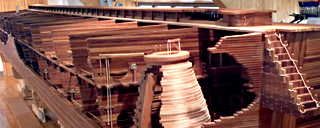
Noah's Ark Replica
Dramatic 25 Foot Detailed Replica
Biosphere Project
Re-creating What It Was Like Before Noah's Flood
11
Apr

Creation Devotional March 14 - Biology

Daily Devotional – March 14

Biology


Electric eels are not eels but fish that live in the murky waters of South America. They can reach 6 feet long and weigh 45 pounds. All living things generate electrical charges in their cells. The electric eel has thousands of modified cells in its tail that are lined up like batteries in a flashlight. Each cell can generate only about 0.15 volts, but stacked together, the 6,000 cells make one giant battery that can generate as much as 600 volts. In comparison, a car battery generates 12 volts yet has enough power to start a large car engine.


Pure water is a very poor conductor of electricity, but the waters where electric eels live have enough salt and other minerals to make the water a good conductor. To shock their prey, electric eels bring their positive end, located in their head, close to the negative end, located in their tail. The electric shock is sent out from the positive end to the negative end of the “battery.” How did the eel know to trap its prey between its head and tail such that the electrical discharge would stun or kill its prey? Basic physics teaches that bringing two opposite electrical poles together concentrates the electric field. Evolutionists call eels “primitive creatures”, but creationists studying eels are not “shocked” by their level of sophistication. God created these creatures to glorify Him.


I will speak of the glorious honour of thy majesty, and of thy wondrous works.

- Psalm 145:5


Source: "Pearls in Paradise" by authors Bruce Malone and Jule Von Vett

References for this devotional.

11
Apr

Creation Devotional March 13 - Geology

Daily Devotional – March 13

Geology


For more than 100 years, oil or “black gold” has fueled our cars,  trucks and economy. But how did these vast fields of oil form? The chemistry of oil offers some important clues. One of the chemicals in crude oils is porphyrin. Most petroleum geologists believe crude oils form mostly from plants, such as diatoms (single-celled marine and freshwater photosynthetic creatures), and beds of coal (huge fossilized masses of plant debris). The moderate heating of brown coals in the lab can produce crude oil and natural gas containing porphyrin. Keep in mind that animal blood also contains porphyrins. Oil can be made from animal slaughterhouse waste within two hours.


For porphyrins to be present in today’s crude oils means they have been kept from the presence of oxygen because porphyrins break down rapidly in the presence of oxygen. We do not see oil containing porphyrins forming today because oxygen destroys them during the oil formation. Yet worldwide, we find vast petroleum deposits that do contain this chemical. This supports the conclusion that much of the world’s oil reserves are the direct result of a worldwide catastrophic flood covering trillions of pounds of vegetation and animals. They were buried so rapidly that oxygen was not present to destroy the porphyrins. Deep rapid burial by additional sediments would have created sufficient heat to generate crude oils and natural gases. Subsequently, these migrated, became trapped in reservoir rocks, and accumulated to form gas and oil deposits. So, from what is oil made? Primarily squished vegetation and animals that were rapidly buried in the Flood of Noah’s day.


And, behold, I, even I, do bring a flood of waters upon the earth….

~ Genesis 6:17


Source: "Pearls in Paradise" by authors Bruce Malone and Jule Von Vett

References for this devotional.

11
Apr

Creation Devotional March 12 - Geology

Daily Devotional – March 12

Geology


How old are diamonds? Scientists have found carbon-14 in diamonds. Carbon-14 (C) has a half-life of 5730 years, and so anything older than 100,000 years should contain no detectable levels of C. Finding C in diamonds means they are less than 100,000 years old. Yet all diamonds contain measurable amounts of C even though they are the hardest known naturally occurring substance, which is impervious to outside contamination. C in diamonds means they are young. There are also other clues revealing the actual age of diamonds.


Kimberlite is a volcanic rock which often contains diamonds. These carrot-shaped rocky tubes begin at the earth’s mantle and rapidly carried diamonds from deep within the earth to the surface. A wooden log that was fresh and unpetrified has been discovered deep within a Canadian kimberlite pipe. There have been other such reports of finding unpetrified wood in kimberlite pipes. How did this wood get deep within the earth, and why is it not petrified or rotted if it has been there for millions of years? Scientists think the logs got there by local catastrophic forces. Fresh unpetrified wood in the same rock as diamonds means diamonds are young. Also, consider that artificial diamonds are rapidly made by the exact same processes of high pressure and temperature as natural diamonds. An artificial diamond can be made in the same amount of time that it takes to wash a car! If we can make artificial diamonds so rapidly, why would we assume it takes billions of years to make natural diamonds?


The evidence of C in diamonds, fresh wood found in kimberlite, and the ability to rapidly make artificial diamonds all cry out, “The earth is young.”


[Mankind] putteth forth his hand upon the rock; he overturneth the mountains by the roots…where shall wisdom be found? and where is the place of understanding?

~ Job 28:9, 12


Source: "Pearls in Paradise" by authors Bruce Malone and Jule Von Vett

References for this devotional.

11
Apr

Creation Devotional March 11 - Design

Daily Devotional – March 11

Design


If we open our eyes, we will see the handiwork of God everywhere. One of these areas is in the design of flowers. Flowers are critical for the complex mechanism by which God reproduces flowering plants. This multiple-step process involves the pollination of flowers to produce seeds, which then produces the next generation of plants. Flowers draw the pollinator to the flower, yet we find some flower designs that just perplex us. Flowers exhibit a dizzying variety of complexity, design, and beauty. What purpose is there for a flower to look like a monkey, a bird flying or a person? What evolutionary function is served by this beauty? Absolutely none! They exist purely for our enjoyment and to reveal God’s incredible genius and creativity.


Why would the Monkey Face Orchid (Dracula Simia) flower decide to make itself look like a monkey? How could the White Egret Orchid (Habenaria Radiata) flower decide to make itself look like a flying bird or even the Naked Man Orchid (Orchis Italica) flower look like a person? These are a few examples of God’s creativity in the design of flowers.


He hath made everything beautiful in his time….

~ Ecclesiastes 3:11


Source: "Pearls in Paradise" by authors Bruce Malone and Jule Von Vett

References for this devotional.

11
Apr

Creation Devotional March 10 - Microbiology

Daily Devotional – March 10

Microbiology


In the last decade, it has become apparent that bacteria are far more varied and versatile than any other kind of creature on Earth. Scientists estimate there is somewhere between 10 million and 1 billion different species of bacteria and have discovered that they are essential for all forms of life – including us! Bacteria help digest the food we eat, provide nutrients, prevent diseases, and produce oxygen. It has also been discovered that bacteria can readily exchange DNA fragments with other bacteria. Because they reproduce so rapidly, this allows the bacteria to test different defenses and environments, capabilities, and strategies for survival. Those that don’t succeed die out while characteristics with an advantage prosper.


So why do bacteria vary so widely? Evolutionists teach that changes in the environment drive bacteria to change; however, that is not true. It is the internal programming of the bacteria that allows them to vary in order to thrive in a wide variety of environments. Evolutionists use the fact that bacteria can transfer DNA coding from one type of bacteria to another as proof of evolutionary advancement, but don’t be fooled by the sleight of hand. What they call evolution is just bacteria doing what they were programmed to do. No one has ever identified a microbe in either the laboratory or the fossil record which is evolving into another kind of creature. They are always clearly identifiable as bacteria.


The vast majority of bacteria are either helpful or harmless, but a small percentage have degenerated into harmful organisms. Even this testifies to the reality of Scripture – death entered into creation because of our rebellion against our Creator, and even the smallest of creatures have become part of the penalty of death, which we brought upon ourselves.


But who so hearkeneth unto me shall dwell safely, and shall be quiet from fear of evil.

~ Proverbs 1:33


Source: "Pearls in Paradise" by authors Bruce Malone and Jule Von Vett

References for this devotional.

11
Apr

Creation Devotional March 9 - Microbiology

Daily Devotional – March 9

Microbiology


One of the most famous chemistry experiments ever performed was the Miller experiment - first reported in 1952. Over 60 years later this experiment is still presented in biology textbooks worldwide as proof that life formed by itself early in the earth’s history. In this experiment, a researcher named Stanley Miller circulated ammonia, methane, hydrogen, and water vapor through a tube and added sparks in order to cause amino acids to form (coined the “building blocks of life”). Yet, students are seldom told the rest of the story.


In order for these amino acids to form proteins, they must link up in a polymerization reaction that requires both ends of the molecule to remain reactive until the entire protein molecule has formed. Visualize a stack of Lego blocks – you can keep adding blocks to the top or bottom of the stack until a block with a flat, undented surface is added to either side. Then no more blocks can be added to that side of the stack. It is now no longer “reactive”. In the Miller experiment, a “flat topped Lego block” is always formed - it is called formic acid. Formic acid is the most common molecule formed during the Miller experiment. The instant formic acid reacts with an amino acid the molecules stop linking up. As a result, no useful protein molecules are ever produced in this experiment.


What this experiment actually demonstrates is that life could not possibly have formed in this way! When problems like this are not shown to students, it is deception, not education. So why is this experiment, which does not work to explain life, still cited in biology books over sixty years later? Textbook writers simply cannot accept the logical conclusion that life can only come from a Creator outside of the time, space, and matter universe. The correct explanation for the existence of life (creation by God) has been eliminated from the thinking of generation after generation of students reading such textbooks. Where does life come from? It’s still a mystery to evolutionists but not to Bible-believing Christians - life comes from God.


And the Lord God formed man of the dust of the ground, and breathed into his nostrils the breath of life; and man became a living soul.

~ Genesis 2:7


Source: "Pearls in Paradise" by authors Bruce Malone and Jule Von Vett

References for this devotional.

11
Apr

Creation Devotional March 8 - Biology

Daily Devotional – March 8

Biology


Have you considered the bird called the whip-poor-will? I remember sleeping at Grandma’s and hearing the night music of the whip-poor-will putting me to sleep. This jay-sized bird makes its home where jack pine forests or oak savannas meet meadows and pastures. This nocturnal bird hunts mosquitoes, moths and beetles. On a moon-lit night, you might see it doing aerial stunts like banking, dipping, diving and hovering to catch its prey. It doesn’t build a nest but lays two eggs on the forest floor in fallen leaves. Both parents care for the young, making frequent hunting trips bringing back regurgitated bug porridge. They also exhibit one other fascinating characteristic - whip-poor-wills time their eggs to hatch exactly 10 days before the full moon. But why?


The bird chicks are at their hungriest about 10 days after hatching. Ten days after they come out of their eggs, the moon is at its brightest. Insects are the easiest to see and catch during a full moon. How did the first whip-poor-will come up with this idea? Did it have a calendar of when the full moon would appear, and then counted back 10 days for the hatching? A bird does not think about this; it comes about by instinct. The precise timing had to be preinstalled on the bird’s software, i.e. its brain. When we see such preinstalled software, we know there must be a software engineer. So, when you hear the night music of the whip-poor-will, think of the greatest software engineer, God.


The flowers appear on the earth; the time of the singing of birds is come, and the voice of the turtle is heard in our land;

~ Song of Solomon 2:12


Source: "Pearls in Paradise" by authors Bruce Malone and Jule Von Vett

References for this devotional.

11
Apr

Creation Devotional March 6 - Botany

Daily Devotional – March 6

Botany


Botanists have long been fascinated by the design of the giant Amazon water lily (Victoria amazonica) with its raised rim that surrounds floating leaves reaching eight feet in diameter. In fact, the lily’s floating leaves can easily support a full-grown adult lying on the thin leaf structure! The secret to the strength of these leaves is the well-engineered supporting veins on the underside of these floating marvels.


Before the very first World’s Fair, being held in London, England in 1851, the organizing committee announced a contest for the best and most original design for the Great Exhibition Hall. Architects and engineers from around the world sent in their designs. Yet, it was not a trained architect, but a botanist named Joseph Paxton, who won the contest. His “Crystal Palace” was to be constructed with 200,000 panes of glass, weighing an estimated one million pounds, supported by a thin iron framework. The entire building was to stand 108 feet tall and cover 18 acres. Experts declared that the foolish structure would collapse before being finished.


Paxton based the design of his building on the same design used to support the heavy leaves of the giant water lily. Not only were the experts wrong, but the beautiful glass building stood as a testimony to the genius of God’s design ability for the next 80 years before being destroyed by fire. Paxton realized that the giant water lily was well engineered; he just copied the greatest Engineer, God Himself.


Through wisdom is a house built.

~ Proverbs 24:3a


Source: "Pearls in Paradise" by authors Bruce Malone and Jule Von Vett

References for this devotional.

11
Apr

Creation Devotional March 5 - History

Daily Devotional – March 5

History


One of the stories from ancient Norway speaks of the existence of a magical glowing stone called the “sunstone.” It was believed that these fabled sunstones aided mariners when the days were so cloudy that the sun was obscured. Vikings write of using these prized sunstones to navigate the perilous Arctic seas. It turns out that sunstone stories are true, there is a transparent spar crystal found in Iceland that creates a double refraction or image. (You can see this for yourself by placing an Iceland spar crystal on a newspaper and seeing a double image appear).


Vikings would mount this crystal of Iceland spar into a wooden block and rotate the block until the two fuzzy images of the sun equalized; from that position, the Vikings could determine the sun’s exact position without a visible sun. Knowing the sun’s location allows sailors to calculate their exact latitude upon the globe. The ancient Vikings were one of the dispersing clans from the Tower of Babel as the Viking civilization is amongst the earliest of European settlers. As one of the earliest human cultures, were they unsophisticated, primitive humans? No, the very opposite is true. They developed advanced technologies needed to survive in the harsh post-Flood world and sailed the globe in search of new resources.


And God said, “Let us make man in our image, after our likeness….”

~ Genesis 1:26


Source: "Pearls in Paradise" by authors Bruce Malone and Jule Von Vett

References for this devotional.

11
Apr

Creation Devotional March 4 - Geology

Daily Devotional – March 4

Geology


During the Flood of Noah’s day not only was the earth covered with water but also with a large number of volcanoes. In fact, you can travel to the very throat of one of these super volcanoes, Yellowstone National Park. That’s right; almost the entire park is a collapsed volcanic cone or caldera. It is 44 miles long and 34 miles wide and covers 1500 square miles in area. Imagine this super volcano spewing out ash and lava!


Evolutionary geology believes in enormous time periods, so it places eruptions that formed the Yellowstone area at 2.1, 1.2, and 0.64 million years ago. Yet these dates are based on dating methods that have been proven to be both inaccurate and subjective. The fact that the collapsed caldera of Yellowstone remains geologically active – creating the geysers, mud pots, hot springs, and fumaroles found throughout the area - actually testifies to its recent creation during the Flood of Noah about 4400 years ago. It remains hot and active because the eruption which created this area DID NOT occur millions of years ago. The underground magma remains hot and close to the surface because the entire area was recently created.


In the six hundredth year of Noah’s life, in the second month, the seventeenth day of the month, the same day were all the fountains of the great deep broken up, and the windows of heaven were opened.

~ Genesis 7:11


Source: "Pearls in Paradise" by authors Bruce Malone and Jule Von Vett

References for this devotional.

ABOUT THE MUSEUM
The Creation Evidence Museum
of Texas is a 501(c)3 non-profit
educational museum chartered
in Texas in 1984 for the purpose
of researching and displaying
scientific evidence for creation.
CONTACT INFO.

3102 FM 205
Glen Rose, Texas 76043
Phone: 254-897-3200

Map Pin   Location Map

HOURS

Thursday - Saturday
10am - 4pm

ADMISSION

$5 Per Person
FREE - Children 5 & Under

Creation Evidence Museum Building

Use & Privacy Policy  |  Site Map

All contents © 2013 Creation Evidence Museum of Texas. All rights reserved. Please note that any use of content downloaded or printed from this site is limited to
non-commercial personal or educational use, including "fair use" as defined by U.S. copyright laws.