











Creation Devotional May 25 - Geology
Daily Devotional – May 25
Geology
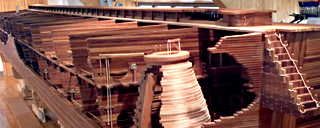
Worldwide, we find bent and folded sedimentary layers. This observation provides strong evidence for a worldwide flood. During the year-long Flood of Noah’s day, many sedimentary layers were laid down in rapid succession. As the mountains rose, these flat layers were bent and folded. For rock layers to fold, they must still be soft and pliable. During the Flood, sediments would be deposited by water into layers, and some water would be trapped. The pressure of the other sedimentary layers on top would have squeezed the particles closer together, forcing much of the water out. The removal of excess water caused the remaining chemicals in the water to turn into natural cement. This cement changed the once soft and wet sedimentary layers into hard, brittle, rock layers. This process is called diagenesis and can happen quickly--within hours, days, or months.
Bent and folded rock layers show that all the bending and folding had to happen when the layers were still soft and pliable, in order to be folded without fracturing. Conventional thinking assumes heat and pressure could have caused these bent and folded layers; however, we do not find metamorphic rocks that would have resulted had high pressure and heat been involved. Bent and folded sedimentary layers are very common in mountainous regions and show us that these layers were laid down in rapid succession during the Flood of Noah’s day, not over millions of years.
They go up by the mountains; they go down by the valleys unto the place which thou hast founded for them.
~ Psalm 104:8
Source: "Pearls in Paradise" by authors Bruce Malone and Jule Von Vett
References for this devotional.
Creation Devotional May 24 - Microbiology
Daily Devotional – May 24
Microbiology
Certain bacteria love to live in the mud, but they do not like oxygen. So, they need to know which way is down, that is, away from oxygen found in higher concentrations nearer to the surface of the mud. Large creatures use gravity to know which way is down, but bacteria are microscopic and do not have any apparatus to sense direction of gravity’s pull.
A graduate student studying these mud-loving bacteria noticed that they would congregate on the north side of the microscope’s slide. So, he placed a bar magnet on the opposite side of the slide, overriding earth’s magnetic field. Sure enough, the bacteria swam to the other side, thinking it was north. In the northern hemisphere, the further north one goes, the more a compass needle dips toward the center of the earth; at the North Pole, the needle dips straight down. If a bacteria had an internal magnetic compass, it would not only guide itself north, but it would have the ability to sense which direction was down and away from oxygen within a mud layer.
Upon further investigation, each bacterium was found to have molecular sized particles of magnetized iron (magnetite or lodestone), arranged in a line along the axis of the cell. Each piece of magnetite was roughly cubic and only about 50 nanometers (or one millionth of a millimeter) on each side. Mankind has never been able to make magnetite particles this small! Since that first discovery of bacteria having a built-in compass, dozens of varieties have been found displaying this same magnetic response. Bacteria with compasses; Jesus loves to surprise us with His creativity!
The north and the south thou hast created them….
~ Psalm 89:12
Source: "Pearls in Paradise" by authors Bruce Malone and Jule Von Vett
References for this devotional.
Creation Devotional May 23 - Biology
Daily Devotional – May 23
Biology
The Bristle-thighed curlew is an amazing bird! When the Alaskanborn chicks are just five weeks old, the parents abandon them and migrate to the South Pacific. For the next few weeks, the chicks go on a feeding frenzy, fattening themselves for the same 5000 mile journey. The young birds are on their own to find the tiny islands of Fiji in the vast Pacific Ocean. They travel non-stop without a guide and arrive with pinpoint accuracy to the same mudflats and sandy beaches where their parents have flown. Unlike seabirds that can stop, rest, and feed along the way, curlews will drown if they land on the ocean. The 5000 mile trip is all or nothing.
How do you explain a curlew’s ability to navigate, untaught, to the opposite hemisphere some 5000 miles across the Pacific, flying non-stop, and landing with pin point accuracy at their winter home? Evolution implies that all this happened by accident and chance. What are the odds? Navigation over vast distances does not happen by accident and chance! The Creator coded within the curlew the route to take. When there is a code, there must be a code-maker, and that codemaker is the Creator God.
The Lord is good to all: and his tender mercies are over all his works.
~ Psalm 145:9
Source: "Pearls in Paradise" by authors Bruce Malone and Jule Von Vett
References for this devotional.
Creation Devotional May 22 - Biblical Accuracy
Daily Devotional – May 22
Biblical Accuracy
What is the smallest seed? The vanilla orchid seed is microscopic in size and to date is acknowledged as the smallest seed. So was Jesus wrong when he stated that the mustard seed was the smallest of all seeds?
Let’s look at the context. Matthew 13:31-32 (NKJ) says, “Another parable He put forth to them, saying: ‘The kingdom of heaven is like a mustard seed, which a man took and sowed in his field, which indeed is the least of all the seeds.’ ” The mustard seed was cultivated during this time. So the mustard seed was spoken of in comparison to other seeds that were sown by the farmers. “It is like a mustard seed which, when it is sown on the ground, is smaller than all the seeds on earth” (Mark 4:31 NKJ). Of the common seeds that are planted by farmers, the mustard seed is indeed the smallest. The Bible is not full of contradictions and falsehoods. Upon closer inspection all questions about its accuracy have clear answers. God inspired the Bible. Biblical truth always remains!
If ye have faith as a grain of mustard seed….
~ Matthew 17:20
Source: "Pearls in Paradise" by authors Bruce Malone and Jule Von Vett
References for this devotional.
Creation Devotional May 21 - Biology
Daily Devotional – May 21
Biology
The size and variety of cats are simply astounding. Yet few people looking at the amazing variety of the cat family--from lions to leopards and panthers to Persians--realize that they are extremely closely related. If it were not for the size differential, all cats could interbreed. Biologists classify different cats (such as lions/tigers, jaguars/cheetahs, margays/ocelots, bobcats/lynxes, and domestic cats) as distinctly different species. Sometimes they are even placed into different biological families because they do not naturally interbreed, live in different environments, and are of vastly different sizes. Yet a 6-pound domestic cat can breed a 15-pound margay; a 15-pound margay can produce offspring with a 30-pound ocelot; a 30-pound ocelot can be crossed with a 80-pound puma, which has been shown to be fertile with a 120-pound leopard, which has been bred with a 250-pound lion, which can produce a striped “liger” when bred with a massive 400-pound tiger.1 Thus, the entire cat family, from one end to the other, is so inner-fertile that the various breeds and families can interbreed. Contrast that with humans and our supposedly “closely-related ancestors.” Scientists have spent years trying to crossbreed humans with apes, chimpanzees, and gorillas, but the gulf is so vast that nothing has ever resulted - because mankind is not related to such animals.
So, how did such vastly different-looking cats originate? God placed all of the information needed to create the enormous variety of cats within an original “cat-type creature.” He then created a process we call “speciation,” which allows variations of offspring to mate in order to fill different environments in which they live. Biologists have shown that it takes as few as 10 generations for a completely new species to develop! God used Noah to preserve all the variety of animal life we find on the earth today. Noah did not need to bring dozens of different kinds of cats upon the ark but only two that had the broad variety of information upon their DNA code to speciate into the variety of cats we see in the world today. And only God would have known which cat had the correct coding. Thus it was God, not Noah, who selected the animals to be taken on the ark!
Of clean beasts, and of beasts that are not clean, and of fowls, and of everything that creepeth upon the earth, there went in two and two unto Noah into the ark, the male and the female, as God had commanded Noah.
~ Genesis 7:8-9
Source: "Pearls in Paradise" by authors Bruce Malone and Jule Von Vett
References for this devotional.
Creation Devotional May 20 - Design
Daily Devotional – May 20
Design
God has put many design features into our world. For example, the earth has a built-in thermostat to help keep the earth’s temperature moderated. When an ocean warms, it causes the amount of water vapor entering the air to increase. If the heating continues, the water vapor will be forced higher into the atmosphere and form icy cirrus clouds. These clouds then reflect the incoming sunlight that decreases the temperature on earth. God uses the clouds as a built-in thermostat. Do we say a thermostat happened by accident and chance? Evolution is based on random changes over time (accident and chance). Why would anyone believe that God’s “cloud thermostat” happened by accident and chance?
Also by watering he wearieth the thick cloud: he scattereth his bright cloud: And it is turned round about by his counsels: that they may do whatsoever he commandeth them upon the face of the world in the earth.
~ Job 37:11-12
Source: "Pearls in Paradise" by authors Bruce Malone and Jule Von Vett
References for this devotional.
Creation Devotional May 19 - Geology
Daily Devotional – May 19
Geology
Sedimentary rock covers almost 75% of the earth’s surface. Have you ever wondered how sedimentary rock layers were made? Let’s find out. Fill a pint jar with ¼ cup pebbles, ¼ cup of white sand (easier to see with white sand but any sand will do) and ¼ cup of ground-up kitty litter with no additives (kitty litter is bentonite clay). Add water until almost full. Place lid on the jar and shake vigorously to mix. Let the jar stand until all the materials are settled and the water becomes somewhat clear. You should see some results of layering in 15 minutes. It will take several hours for the water to become clear (clay particles settle slowly). Moving water has the ability to separate sediments into layers.
During the Flood of Noah’s day, rocks were ground up in the cataclysmic flood, then transported and laid down. Evolutionists believe that sedimentary layers took millions of years to form, but with your “flood jar,” we observe layers being formed quickly. Sedimentary rock layers are not a monument to time; the rock layers are a monument to the Genesis Flood.
And he answered and said unto them, I tell you that, if these should hold their peace, the stones would immediately cry out.
~ Luke 19:40
Source: "Pearls in Paradise" by authors Bruce Malone and Jule Von Vett
References for this devotional.
Creation Devotional May 18 - Biology
Daily Devotional – May 18
Biology
The oceans are full of amazing creatures, but none are masters of disguise like the cuttlefish. This creature has been coined “The King of Camouflage.” It can distort its body into 40 different body shapes mimicking everything from a starfish to a squid; change its skin texture to mimic its background like corals, kelps or rocks; display a dizzying array of motions from swaying seaweed to swimming fish; change colors across the spectrum from red to blue to yellow; and flash zebralike patterns across its body. And all of these colors, textures, shapes, and patterns can be changed within seconds!
One scientist studying the cuttlefish was amazed as he watched each cuttlefish transform into a “tailor-made camouflage pattern” for a particular microhabitat. Two identical cuttlefish settled to the ocean bottom. One instantly took on the coloration and texture of sand and disappeared into the background. The other was only ten feet away where algae covered the ocean bottom, and it took on the coloration and texture of algae. Each of these two cuttlefish “tailor-made” its camouflage pattern.
How are cuttlefish able to do this when they cannot even see their skin? In fact, scientists believe cuttlefish are even colorblind, only seeing the color green! The scientist was right in calling these cuttlefish “tailormade”; they were tailor-made by the great Tailor, God Himself!
The Lord reigneth; let the earth rejoice; let the multitude of isles be glad thereof.
~ Psalm 97:1
Source: "Pearls in Paradise" by authors Bruce Malone and Jule Von Vett
References for this devotional.
Creation Devotional May 17 - Botany
Daily Devotional – May 17
Botany
Did you know vanilla comes from an orchid, the vanilla planifolia plant? This orchid grows up trees as a vine. Unlike most orchids, this one blooms only one morning each year and only for a few hours and then it wilts. While it is blooming, it needs to be pollinated, otherwise no vanilla bean will develop. God has created this plant to be pollinated by a small flea-sized bee called the Mexican Melipona bee. It is the only insect capable of pollinating this orchid.
After landing on the flower, the bee lifts up the hood, collects the pollen and flies to another vanilla orchid. Once pollinated, a vanilla bean will be produced. Hernan Cortes, the Spanish conquistador who caused the fall of the Aztecs in Mexico, loved vanilla and brought back the vanilla orchid to Europe. For 300 years, Europeans grew the plant from cuttings, but no vanilla beans were produced! Then in 1836, a Frenchman went to Mexico and sat and watched the vanilla orchid. He heard the buzzing sound of the Mexican Melipona bee as it pollinated the orchid. The secret to vanilla beans was discovered! This bee knew how to lift the hood and go in; no other insect can do this! This bee is made for this orchid, and this orchid is made for this bee. They were made for each other. How do evolutionists explain this? If it did not work the first time, the first generation of the vanilla plants would have become extinct. So as you enjoy that delicious vanilla ice cream, thank God for a little bee and a vanilla orchid.
Sing unto the Lord; for he hath done excellent things: this is known in all the earth.
~ Isaiah 12:5
Source: "Pearls in Paradise" by authors Bruce Malone and Jule Von Vett
References for this devotional.
Creation Devotional May 16 - Christian Truth
Daily Devotional – May 16
Christian Truth
Few people in history have suffered as dramatically as Job. In a brief period of time, he lost his enormous wealth, his stature/fame/prestige, and every one of his ten children, and he was covered with excruciatingly painful boils - causing him continuous, unstoppable agony. His only momentary relief was to scrape his skin with a piece of broken pottery so hard that his entire body became a raw, oozing sore. His closest friends could not even recognize him, and his wife’s only advice was to, “Curse God and die!” (Job 2:9). Yet in the face of such monumental suffering, Job correctly acknowledges this reality: “Shall we accept good from God, and not trouble?”(Job 2:10 NIV).
How a loving God can allow human suffering has been a central question throughout the ages – especially when we are the ones in anguish. Every human being stands sinful before God, and we deserve death for our rebellion. Yet, God took the penalty of death upon Himself in an act of unconditional, sacrificial love. While God sees the big picture and what the future holds, we constantly turn from Him in self-centered desires. Physical death exists as the only possible door for believers to come back into fellowship with God. But how could we die if disease and sickness did not exist? How could we help and empathize with others if nothing “bad” ever happened to us? How could we truly appreciate the blessings of God if we never experience the removal of these blessings? God understands suffering and knows what is best for us. It is through the tough times that we draw closest to him.
Job repeatedly acknowledged that God was both aware of his pain and was allowing him to experience it. In a classic and prophetic statement, Job declared, “I know that my redeemer lives.” (Job 19:25 NKJ). Yet, Job cried out for an explanation of why he was going through such anguish. In the end, God did answer this question. Throughout four chapters of Scripture, in the longest recorded monolog from God to mankind, God explains His majesty, power, understanding and control over all things to Job and each one of us. Jesus Himself stated as fact, “In this world you will have trouble.” (John 16:33 NIV) When you are suffering, concentrate on the height of God’s majesty - not the depth of your sorrows. These things I have spoken unto you, that in me ye might have peace.
In the world ye shall have tribulation: but be of good cheer; I have overcome the world.
~ John 16:33
Source: "Pearls in Paradise" by authors Bruce Malone and Jule Von Vett
References for this devotional.

 Call 254-897-3200