











Creation Devotional June 4 - History
Daily Devotional – June 4
History
Oceans cover about 70% of our planet’s surface and contain enough water that, if the Earth’s surface were completely flat, the water would cover the whole planet to a depth of over 8000 feet (1.7 miles). Based on actual observation, the Earth is the only planet in the entire universe to have liquid water on its surface.
Streams, rivers, and other sources of land runoff are continually flowing into the oceans and dumping various salts and dissolved minerals into that water. Using today’s rate of salt input and output, scientists estimate that the oceans could be AT MOST 62 million years old. This is not the actual age but a maximum age. Even if the oceans started as pure distilled water (which seems highly unlikely), the salt concentration would have reached today’s level in about 62 million years. Yet, evolutionists tell us the oceans are 3 BILLION years old. If that were true, the oceans should be FAR saltier! The reason the oceans currently have “62 million years-worth of salt” could be that God created the oceans with some salt, at the beginning. Then the Genesis Flood would have very rapidly added salt. The amount of salt in the world’s ocean water is strong evidence that the Earth is far younger than the billions of years required for evolution. The amount of salt is actually quite consistent with a biblical age of about 6,000 years.
The sea is his, and he made it
~ Psalm 95:5
Source: "Pearls in Paradise" by authors Bruce Malone and Jule Von Vett
References for this devotional.
Creation Devotional June 3 - Geology
Daily Devotional – June 3
Geology
Scientists believe they have discovered three times more water deep within the Earth’s mantle than in all the oceans of the world. But before you grab your bathing suit and surfboard and book a trip to where the Sun doesn’t shine, consider that this vast reservoir of water is located 420 miles below the earth’s surface (50 times lower than the deepest oil well). It is also locked up as hydrated molecules within the Earth’s magma and rock crystal structure.
What makes this discovery so significant is the fact that scientists cannot even explain where all the water that fills our current oceans came from, let alone more water locked deep within the Earth. This water is a total mystery to scientists studying the Earth from an evolutionary, old-age perspective. All naturalistic models for the Earth’s formation require enormous amounts of heat as materials slowly coalesced to form our planet - billions of years ago. These processes would have driven water out of the Earth’s core and left little on the surface. So, speculation has proposed that our oceans came from vast numbers of comets hitting the Earth and depositing their water. This also does not work because water contained in comets has been shown to have a very different composition of isotopes than water found on Earth.
The Bible states that the Earth was recently created “out of water” (2 Peter 3:5 NKJV) and made for mankind’s benefit (Psalm 115:16). Finding oceans filled with water (and even more water deep below the surface) is neither surprising nor a mystery.
Towards the end of the Flood of Noah’s day, the mountains rose up, and the waters rushed off the continents into the oceans. This is where the waters that flooded the Earth now reside. Much of this water may have originally come from sources deep within the Earth when “all the fountains of the great deep were broken up” (Genesis 7:11 NKJV) approximately 4,350 years ago.
For this they willingly are ignorant of, that by the word of God the heavens were of old, and the earth standing out of the water and in the water: Whereby the world that then was, being overflowed with water, perished:
~ 2 Peter 3:5-6
Source: "Pearls in Paradise" by authors Bruce Malone and Jule Von Vett
References for this devotional.
Creation Devotional June 2 - Biology
Daily Devotional – June 2
Biology
Prairie dogs are not dogs, but they are rodents classified with the squirrel family. They live in underground tunnels and chambers that create entire “towns” housing hundreds of prairie dogs on the plains of North America. Their underground tunnels contain multiple rooms - including bedrooms, nurseries, and bathrooms. These burrows even include a “listening room” close to the entrance, where the prairie dog listens for danger before going outside. One would think that the air would become stale in these underground burrows, however, the entire complex is nicely ventilated.
Each home has at least two openings. Prairie dogs surround these two holes with piles of dirt but always make one mound taller than the other mound. When a breeze blows across the top of these mounds, a pressure differential occurs, causing air to be aspirated up, creating a partial vacuum in the tunnels, and thereby drawing air into the lower opening. These prairie dogs have engineered a passive ventilation system that uses the Bernoulli principle! God created these animals with the instinct to build one mound higher than the other. This creates a draft or chimney effect that draws fresh air into the tunnel and allows it to circulate throughout. In essence, during the summer, the prairie dog town is “air conditioned.” When the above ground temperature exceeds 100oF, the burrow temperature one foot below is a comfortable 55oF. During the winter, the snow covers the “chimney”, not allowing the cold air to enter the tunnels. How does evolution explain this engineering ability? God gave the engineering instinct to these creatures, so they can survive extreme weather conditions found on the northern Great Plains.
To him who alone doeth great wonders.…
~ Psalm 136:4
Source: "Pearls in Paradise" by authors Bruce Malone and Jule Von Vett
References for this devotional.
Creation Devotional June 1 - Anatomy
Daily Devotional – June 1
Anatomy
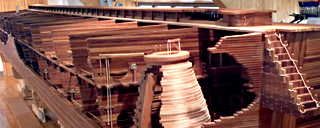
What do the Eiffel Tower and the thigh bone have in common? The 1889 World’s Fair was coming up, and Mr. Eiffel wanted to win the architect’s contest by designing the most daring structure. The winning design would commemorate this great event.
Gustave Eiffel went to an unusual source for his design idea: the human thigh bone. The thigh bone connects to the hip and extends sideways, causing the body’s weight to be moved off-center. When the thigh bone’s head was examined internally, it was found to have beautifully curving lines from the head, while other bone fibers crossed over it. This bony crisscross pattern is like a diagram showing the lines of stress within the loaded structure. In other words, the thigh bone was strengthened in exactly the manner and direction in which the strength was required.
Mr. Eiffel simply copied the thigh bone structure using wrought iron in place of bone and designed the now famous, flared tower. Even though Mr. Eiffel won the contest, the competing architects scoffed and predicted the tower would collapse under its own weight. It still stands today, a century later. But of course it would; Mr. Eiffel just copied what has been allowing us to stand all these years, our thigh bone. Maybe we should rename this famous structure the “Thigh Tower” … or better yet – “God’s Tower”. After all, the Eiffel Tower is really His design.
Thine hands have made me and fashioned me together round about
~ Job 10:8
Source: "Pearls in Paradise" by authors Bruce Malone and Jule Von Vett
References for this devotional.
Creation Devotional May 31 - Cosmology
Daily Devotional – May 31
Cosmology
The universe is filled with indications of great age, yet God’s Word tells us, “In six days the Lord made THE HEAVENS and the earth....” (Exodus 20:11 emphasis added). Star deterioration, supernovas, and colossal distances all seem to testify to an extremely old universe. So how could God have made the entire universe quite recently in only “six days”?
When the Bible states: “In six days…”, we have to know at what location these “six days” of time occurred. Since the earth’s rotation is the measure of a “day”--and the earth is the central focus of the biblical account of history—it seems rather straightforward that six literal earth days, measured at the earth’s location within space, is the measure of time in which the universe was created. Yet, time moves at different rates depending on the location where the passage of time is occurring. It has been found that a clock at sea-level runs a tiny fraction of a percent slower than a clock on top of a mountain. A brilliant Bible-believing physicist, Dr. Russell Humphreys, has proven that millions of years could have passed further out in space while only six days were passing on the earth!
As the very fabric of space was being stretched out, time in some areas would have literally stopped. Meanwhile, millions and even billions of years could have been passing only slightly further out. Near the center of the universe, time essentially stood still in comparison to areas outside of an event boundary. Thus on “day four”, when the stars were made, there would have been a massive increase in the mass of the universe, and literally billions of years could have passed outside of our solar system (as the stars of the universe were being created and aging), while only a literal day was passing here on earth. This is called time dilation. This is not deceptive on the part of God – just the mathematical consequence of making and stretching out the universe.
We have to remember God’s Word is true; He created in six days about 6,000 years ago (according to the genealogical biblical records). How He did it is difficult to understand. God delights in showing us His power through the things He has made.
It is he... that stretcheth out the heavens as a curtain, and spreadeth them out as a tent to dwell in.
~ Isaiah 40:22
“If the world hate you, ye know that it hated me before it hated you,”
~ John 15:18
“You have enemies? Good! That means you’ve stood up for something, sometime in your life.”
~ Winston Churchill (1874-1965), Prime Minister of Great Britain during World War II
Source: "Pearls in Paradise" by authors Bruce Malone and Jule Von Vett
References for this devotional.
Creation Devotional May 30 - Paleontology
Daily Devotional – May 30
Paleontology
In modern-day Cambodia stands the ancient temples of Angkor, which were built in the 12th century. These temple buildings are decorated with thousands of animal images carved into the stone. Hundreds of these decorations are circular reliefs with a central animal. Many of these carved animal images are familiar - such as deer, water buffalo, monkeys, parrots, swans, and lizards. In every image, the representation is of a real creature that the artist has seen. In one of those decorative stone circles is the carving of a stegosaurus.
A stegosaurus is a dinosaur that looks like a heavily armored tank with spikes on its tail and large plates along its spine. Evolutionists say that dinosaurs became extinct over 65 million years ago. If this really were the truth, no human being could ever have seen a stegosaurus. Yet, we have seen one carved on a temple dating about 900 years ago. If school children were shown a picture of this carving, they would instantly recognize it as a stegosaurus. On page 213 of his book Angkor, Cities and Temples, Claude Jacques describes this carving as “an animal which bears a striking resemblance to a stegosaurus.” What does this mean? The relief carver had to have seen a stegosaurus. This should not surprise us for we were both made on the same day of creation week, Day 6. Dinosaurs and man did live together, and ancient man recorded it in his artwork. Dinosaurs today seem to have finally gone extinct, just like the dodo bird and the passenger pigeon, but only 900 years ago, there is evidence to support the reality that at least a few were still around.
Behold now behemoth, which I made with thee….
~ Job 40:15
Source: "Pearls in Paradise" by authors Bruce Malone and Jule Von Vett
References for this devotional.
Creation Devotional May 29 - Biology
Daily Devotional – May 29
Biology
In the shallow waters of Africa lives the Black Heron, which has an incredibly creative way of catching its food. Sunlight can cause a harsh glare on the surface of water, making it nearly impossible for the Black Heron to see into the water and find fish. In addition, fish tend to avoid the bright sunshine at the water’s surface. So, what does a Black Heron (also known as the “umbrella bird”) do?
As he slowly wades through the shallow waters, he spreads his wings, forming a dome-shaped black umbrella over the water. Then, he crouches down until the wings almost touch the water’s surface. The fish think this darkened area is a good place to hide, just like under a lily pad. But in the case of the Black Heron, it is actually a trap for these little fish. As soon as an unsuspecting fish swims over into the shade, the umbrella bird pokes his head into the water and comes out with a squirming fish. Ask any fisherman which part of the lake he gets the best catches and he will say, “The shady part.” How did the umbrella bird learn to hunt in this way? Evolutionists call this “canopy feeding,” but just because they name it doesn’t mean they understand it. As Bible believers, we do; God created the umbrella bird to fish in such a manner.
And blessed be his glorious name for ever: and let the whole earth be filled with his glory; Amen, and Amen.
~ Psalm 72:19
Source: "Pearls in Paradise" by authors Bruce Malone and Jule Von Vett
References for this devotional.
Creation Devotional May 28 - Biology
Daily Devotional – May 28
Biology
Did you ever wonder how perching birds can sleep on branches without falling off? God has given them a special toe-locking device! In each leg is a tendon that is attached to the underside of the toes, stretching up the leg to the back of the “ankle,” and attaching to the leg muscle. When the bird relaxes, it bends its “ankle” which pulls on the tendon and causes the toes to curl more tightly. The more the bird relaxes the more it bends, and the more it curls its toes. The tendon even has hundreds of ratchet-like projections that mesh with the grooves in the tendon sheath. It is virtually impossible for a bird to fall off a perch while sleeping. As the bird stands up, the tendon is relaxed, and the feet are released.
Evolutionists would have us believe that this special toe-locking device happened by accidental changes over millions of years. If the tendon was present without the ratchetlike projections, how would the tendon stay taunt? And what about the ratchet-like projections, they require a complimentary groove for them to function properly? These parts had to be present from the beginning. Our Creator cares even for the way a bird perches.
The kingdom of heaven is like to a grain of mustard seed, which a man took, and sowed in his field: Which indeed is the least of all seeds: but when it is grown, it is the greatest among herbs, and becometh a tree, so that the birds of the air come and lodge in the branches thereof.
~ Matthew 13:31-32
Source: "Pearls in Paradise" by authors Bruce Malone and Jule Von Vett
References for this devotional.
Creation Devotional May 27 - Biology
Daily Devotional – May 27
Biology
The beaver is uniquely designed for a semi-aquatic life. It has special valves in its nose and ears that close automatically when underwater. To see well underwater, it has transparent eyelids that act like swimming goggles. When a branch-carrying beaver is swimming, how does it not choke on water going down its mouth? Behind its front teeth are two flaps of skin that close tightly to prevent water from entering the beaver’s throat. Its tail is used as a rudder when swimming or a balance support when standing upright. Its tail also radiates heat when its body is too warm. The rear feet are webbed like a duck’s - for good swimming-while the front feet are unwebbed, so it can dig canals and carry branches. To keep itself from hypothermia the fur is richly oiled by two oil glands which the beaver spreads on its fur; water rarely touches its skin. Fat below the skin further protects it from the cold. And, of course, beavers are known for their teeth and the ability to gnaw trees down and eat them. For this, they have continually growing incisors. Beavers just have to gnaw!
All of these beaver features had to be present and fully functioning from the beginning in order to survive. What if their teeth never grew after gnawing on trees? They would be ground down, and the beaver could not survive. What if the mouth flaps were not present? Water would flood their throat, choking them. Imagine digging canals with webbed front feet or swimming with no webbed back feet. The beaver is a showcase of God’s creativity.
Remember now thy Creator in the days of thy youth…
~ Ecclesiastes 12:1
Source: "Pearls in Paradise" by authors Bruce Malone and Jule Von Vett
References for this devotional.
Creation Devotional May 26 - Paleontology
Daily Devotional – May 26
Paleontology
Textbooks, TV programs, and museums place distinct 12 geological rock strata in a vertical order and name this sequence, “the geological column.” In this geologic column, the rock layers or strata form a sequence from top to bottom. Yet, the complete geological column is not found at any location on earth, it is only found in diagrams!
Before the 1800s, the sequence of different rock layers (and fossils found within these rocks) were known, but the general order was acknowledged to exist as a result of these rock layers being formed during the year-long Flood of Noah’s time. First buried were the sea creatures and later, as the flood waters increased, land creatures were buried. The geologic column was the order of what was caught in the Flood. During the late1800s, evolution became popular, so the meaning of the geological column changed. It now was a tool for promoting the evolution of life - from bacteria to people, over millions of years. But what do we find in the fossil record of this geological column?
Near the very bottom of the geological column is the Cambrian layer. In the Cambrian layer, we find fossil remains of complex creatures from most of the major animal groups. In fact, we find representatives of every major animal phylum both alive today and those that are now extinct. This explosion of complex life is called the “Cambrian Explosion.” The Cambrian Explosion is actually explosive evidence against slow and gradual evolution! When we study the facts, we find God’s word is true. The Bible states in clear straightforward terms that God created all plants and animals on earth in six literal days. Over a thousand years later, the Flood of Noah took place, leaving behind the fossil evidence. The “Cambrian Explosion” testifies to the accuracy of Scripture.
For in six days the Lord made heaven and earth, the sea, and all that in them is, and rested the seventh day: wherefore the Lord blessed the sabbath day, and hallowed it.
~ Exodus 20:11
Source: "Pearls in Paradise" by authors Bruce Malone and Jule Von Vett
References for this devotional.

 Call 254-897-3200