






Location
 Contact Us
 
Creation Model
Noah's Ark
Hyperbaric Biosphere
Creation In Symphony Videos Now Online
Watch the entire video series on our YouTube Channel
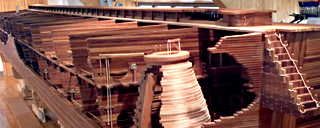
Noah's Ark Replica
Dramatic 25 Foot Detailed Replica
Biosphere Project
Re-creating What It Was Like Before Noah's Flood
8
Jul

Creation Devotional July 7 - Biology

Daily Devotional – July 7

Biology


Students are taught about light and dark-colored peppered moths in almost all biology textbooks. Here’s the story: prior to the Industrial Revolution, light-colored peppered moths were prevalent in England. During the Industrial Revolution, soot covered the trees, and the dark-colored peppered moths were better camouflaged. Therefore, they had an advantage and survived better than the light-colored moths. This is often called an example of “evolution in action.”


Today, England’s trees are not soot covered, and light-colored moths are as prevalent as before the Industrial Revolution. This shift in colors is not evolution in action; remember, both varieties of moths were present from the start. As the environment changed, the dark-colored moths had greater opportunity to pass on their genes for darkness than the light-colored ones. With the environment changing again, we now see the lighter ones flourishing. This is natural selection in action, not evolution. Evolution needs proof that one creature changes into another completely different kind of creature. No such proof has ever been seen.


Furthermore, these light and dark-colored peppered moths did NOT spend time on exposed tree trunks and rocks as the famous textbook pictures show. Those promoting this idea in textbooks have now admitted that they glued the moths on the tree trunks; the photographs were fakes. In reality, peppered moths are nocturnal and rest in tree tops during the day. Don’t believe everything you read in your textbooks! But do believe everything in the Bible. God, not evolution, created peppered moths from the beginning.


In the beginning God created the heaven and the earth.

~ Genesis 1:1


Source: "Pearls in Paradise" by authors Bruce Malone and Jule Von Vett

References for this devotional.

8
Jul

Creation Devotional July 5 - Biology

Daily Devotional – July 5

Biology


What are the “evolutionist’s tree of life” and the “creationist’s orchard”? Darwin originally proposed that all life had a common-origin ancestor and the various forms of life could be lined up into a “tree of life” showing what turned into what. “Common descent” is still the foundational principle ruling modern biology. Evolutionists believe that all of today’s species are descended from one common ancestor and that every organism we see today evolved from one simple cell.


In contrast, the creationist’s orchard has diversity occurring with time, but always within the basic body types or the Genesis “kinds.” In the beginning, God created the creatures “according to their kinds” (Gen. 1: 11- 12, 21, 24-25). Each of these kinds was created with a vast amount of information but always within limits. Written into the DNA coding of each “tree” within the biological orchard of life, is enough variety that descendants can adapt to a wide variety of environments. Creatures only breed with other creatures of their own kind. For example, dogs, wolves, and coyotes belong to the canine kind while cats, lions and tigers belong to the feline kind. There is no connection between the canine tree and the feline tree. There is no shared ancestry. We do not find “cogs” and “dats” but cats and dogs. The biblical orchard best fits what we observe in nature.

And God made the beast of the earth after his kind, and cattle after their kind, and everything that creepeth upon the earth after his kind:  and God saw that it was good.

~ Genesis 1:25


Source: "Pearls in Paradise" by authors Bruce Malone and Jule Von Vett

8
Jul

Creation Devotional July 2 - Biology

Daily Devotional – July 2

Biology


The caterpillar of the tropical butterfly Heliconius sara eats nothing but the leaves of the passion vines. Problem - these leaves contain cyanide packets along with enzyme packets so that when chewed and mixed together, deadly cyanide gas is released! The result for unwary, hungry insects – death!


However, H. sara caterpillars do not die. Why? Biologists found that when these caterpillars munched on the leaves, the caterpillars released a neutralizing enzyme that changed the cyanide into a harmless chemical. Evolutionists would have us believe that these caterpillars evolved the ability to neutralize the cyanide by accident and chance. Any insect that munched on the passion vine leaf without the neutralizing enzyme would face instant death. H. sara caterpillars had to have this special enzyme from the beginning! God, the greatest Chemist, designed this neutralizing ability from the start in order for the beautiful tropical butterfly Heliconius sara to exist.


For he spake, and it was done;….

~ Psalm 33:9


Source: "Pearls in Paradise" by authors Bruce Malone and Jule Von Vett

8
Jul

Creation Devotional June 28 - Biology

Daily Devotional – June 28

Biology


One of the most remarkable builders in the animal kingdom is the beaver. The sound of trickling water stimulates the beaver to plug the flow by building a dam. If it is a sluggish stream, the dam will be built straight across. If it is a fast-flowing stream, the beaver will construct a dam with a convex curve in the upstream direction. First, they push strong sticks down into the stream bed. Next, they fill the gaps with branches. Finally, they place heavier rocks or pieces of wood on top. Beavers know how to compensate for the stresses and strains of water pushing against the dam. On the upstream side of the dam, the wall is vertical and on the downstream side, the wall slopes at a 45 degree angle. Beavers also build outlet sluices for removal of overflow water.


Dams can be built short or long, high or low. One beaver dam was 1800 feet long, 9 feet high and 18 feet wide, strong enough for a horse and rider to use as a natural bridge! When we build dams, great engineering is needed to stop the flow and resist water pressure. Do we say that the engineering of our dams happen by accident and chance? It takes years of schooling to be a good dam builder, but beavers know instinctively how to build a dam. Even if a beaver is born in a zoo and let go in the wild, it still knows how to build a dam. Beavers do not need to learn how to build a dam, they just know; it’s called instinct. If there is instinct, there must be an instinct maker and that instinct maker is God.


Give thanks unto the Lord, call upon his name, make known his deeds among the people.

~1 Chronicles 16:8


Source: "Pearls in Paradise" by authors Bruce Malone and Jule Von Vett

References for this devotional.

8
Jul

Creation Devotional June 23 - Biology

Daily Devotional – June 23

Biology


One of the wonders of the Pacific Ocean is the Japanese puffer fish. During mating season this fish creates an underwater sculpture which would astound any artist and make a beautiful wall decoration in any home. Using only it fins, the tiny fish produces a perfectly circular, six-foot sculpture on the ocean bottom with uniquely placed ridges and channels. The fish cannot even see from one side of the sculpture to the other, yet it is a perfect circle and the channels it creates between the sand ridges are produced with mathematically perfection.


The fish literally has a map of the finished sculpture in its brain and works non-stop, 24 hours a day, for over a week to complete the plan. Where did this plan come from? How did it learn to move sand, shells and rocks around to create such beauty? Could such plans and ability have slowly “evolved” over time a small step at a time? Not a chance! God created such wonders to show us his creativity in the animals he has made.


For all those things hath mine hand made...

~ Isaiah 66:2a


Source: "Pearls in Paradise" by authors Bruce Malone and Jule Von Vett

References for this devotional.

8
Jul

Creation Devotional June 20 - Biology

Daily Devotional – June 20

Biology


Have you heard of the boxer crab? It carries around pom poms like a high school cheerleader - but its pom poms are deadly sea anemones. The crab uses these anemones to sting small animals in order to eat them. The sea anemones then share in the meal. This is a mutually beneficial (symbiotic) relationship. The tiny boxer crab, measuring only one inch across, would be an easy lunch without the protection of the stinging sea anemones. The threat of a one-two punch from the sea anemone’s “pom poms” is enough to scare most predators away. If the predator is not scared away, the stinging cells on the sea anemone’s tentacles have enough poison to kill small animals – now the predator is lunch! God in His wisdom knew that boxer crabs and sea anemones would need each other and so designed this symbiotic relationship to benefit each animal.


He is wise in heart, and mighty in strength: who hath hardened himself against him, and hath prospered?

~ Job 9:4


Source: "Pearls in Paradise" by authors Bruce Malone and Jule Von Vett

References for this devotional.

8
Jul

Creation Devotional June 16 - Biology

Daily Devotional – June 16

Biology


The Texas horned toad is found all over the western United States. It has a stubby nose, horns on its head, spikes all over its body and tail. It may look dangerous to us, but it is friendly. If you are a predator, the horned toad displays a full arsenal of defensive weapons. When frightened, the horned toad first flattens itself to the ground and freezes, not moving a muscle. If a predator continues to approach, it runs with short bursts and then stops quickly - repeating as necessary. If the predator is still pursuing, it will blow itself up to be twice its size. And then there is the final trick; the toad can shoot a stream of blood out of its eyeball up to five feet away! He can even aim this blood stream! He can do this 2-3 times. The blood tastes nasty, so any coyote, snake, or roadrunner that wants to mess with a Texas horned toad has to be ready!


Imagine if we were to burst an artery in our eye, it would take a long time for it to heal, and it would likely leave scar tissue. Not so with the horned toad. It can shoot blood again and again without permanent harm. What if it took millions of years to develop this ability? The horned toad would have probably been eaten. No other animal can squirt blood out of its eyes. We have an imaginative Creator who is concerned for even a small, cold-blooded lizard’s protection. We have a Creator that makes amazing creatures!


For the Lord is great, and greatly to be praised:….

~ Psalm 96:4


Source: "Pearls in Paradise" by authors Bruce Malone and Jule Von Vett

References for this devotional.

8
Jul

Creation Devotional June 14 - Biology

Daily Devotional – June 14

Biology


How does an octopus change the color of its skin to match his surroundings in the blink of an eye? Below the top layer of protective skin, an octopus has three more layers (chromatophore layers) with thousands of tiny, balloon-like sacs filled with different pigment colors. The top layer of chromatophores has black and brown colored sacs, the middle layer has red and orange colored sacs, and the third layer has yellow colored sacs. Nerves and muscles cause the balloon-like sacs to expand and contract. When the sac expands, the color in that layer becomes more visible, and when contracted, the color becomes less visible. But the octopus camouflage system is even more complex. The fifth layer down is filled with iridophores, which are reflecting plates that give the octopus iridescent golds, silvers, blues and greens. The sixth or bottom layer contains leucophores, which mirror back colors from any surrounding environments.


Octopus skin has inspired researchers to develop a high-tech camouflage fabric. So far, the fabric can automatically shift between white and black as well as making shades of gray. One of the engineers noted that, “…looking at moves of squid, octopuses, and cuttlefish, you just (realize) that you’re not going to get close to that level of sophistication.” This engineer knows the difficulty of making such a fabric. When man tries to copy what has already been made but cannot even come close, we must stand in awe of the original design Engineer, God, Himself!


Let the heavens be glad, and let the earth rejoice: and let men say among the nations, The Lord reigneth. Let the sea roar, and the fulness thereof: let the fields rejoice, and all that is therein.

~ 1 Chronicles 16: 31-32


Source: "Pearls in Paradise" by authors Bruce Malone and Jule Von Vett

References for this devotional.

8
Jul

Creation Devotional June 11 - Biology

Daily Devotional – June 11

Biology


Spider webs are known for their strength, but that is not the only thing needed to capture a flying insect. The web needs to be sticky, and spider webs are definitely sticky. You may have noticed this when cleaning up cobwebs – they are very difficult to remove from your hands. Spiders place tiny glue droplets, about 20 drops every 1/16 inch, along certain strands of their spider web. Their insect prey is caught by this glue. But this is no ordinary glue that just sticks things together. This glue is “smart glue.”


Imagine a flying insect hitting the super-sticky web and getting glued on. The spider needs to remove the insect without getting himself stuck, but how does he do it? He waits patiently. This glue is the stickiest when the flying insect hits the web at high speed. When the insect struggles in the web at a lower speed, this glue acts like a rubber band. When the struggling insect tires and stops moving, the glue gets even less sticky - allowing the spider to pull its prey loose and retrieve its meal. Researchers are now trying to copy this “smart glue” that has variable stickiness according to each situation. Scientists recognize a good design when they see it. If there is a design, there must be a Designer, and that is God.


O give thanks unto the Lord; call upon his name:  make known his deeds among the people.

~ Psalm 105:1


Source: "Pearls in Paradise" by authors Bruce Malone and Jule Von Vett

References for this devotional.

10
Jun

Creation Devotional June 10 - Biology

Daily Devotional – June 10

Biology


Have you ever thought about a spider web saving a bird? Every year, many birds are killed when they fly into window glass. Either they can’t see the window glass, or they see the reflections of nearby trees, sky, and other objects - either way, they slam into the window glass and are killed. It has been found, however, that spiders that spin orb webs (spiral wheel shaped webs) use silk that reflects ultraviolet light. We can’t see the UV light, as it is outside the range of human vision, but many birds and insects can see it. Biologists have discovered that the use of this UV-reflecting web material serves two important purposes:


  1. It attracts insects like a neon sign; some webs even display a flowerlike pattern.
  2. It warns birds not to fly into the web as if to say, “I don’t want to rebuild this web, so please avoid.”


The Arnold Glass Corporation has copied this UV reflecting property by coating their glass with criss-crossing UV reflecting strips. This coating is invisible to humans but not to birds. Birds make every effort to avoid this UV-treated glass. Nature is filled with design ideas, but of course, God put them there when He created the world! His power is displayed through what He has made. Who would have thought that spider webs would lead to protecting birds!


By the word of the LORD were the heavens made; and all the host of them by the breath of his mouth. He gathereth the waters of the sea together as an heap: he layeth up the depth in storehouses. Let all the earth fear the LORD: let all the inhabitants of the world stand in awe of him. For he spake, and it was done; he commanded, and it stood fast.

~ Psalm 33:6-9


Source: "Pearls in Paradise" by authors Bruce Malone and Jule Von Vett

References for this devotional.

ABOUT THE MUSEUM
The Creation Evidence Museum
of Texas is a 501(c)3 non-profit
educational museum chartered
in Texas in 1984 for the purpose
of researching and displaying
scientific evidence for creation.
CONTACT INFO.

3102 FM 205
Glen Rose, Texas 76043
Phone: 254-897-3200

Map Pin   Location Map

HOURS

Thursday - Saturday
10am - 4pm

ADMISSION

$5 Per Person
FREE - Children 5 & Under

Creation Evidence Museum Building

Use & Privacy Policy  |  Site Map

All contents © 2013 Creation Evidence Museum of Texas. All rights reserved. Please note that any use of content downloaded or printed from this site is limited to
non-commercial personal or educational use, including "fair use" as defined by U.S. copyright laws.