






Location
 Contact Us
 
Creation Model
Noah's Ark
Hyperbaric Biosphere
Creation In Symphony Videos Now Online
Watch the entire video series on our YouTube Channel
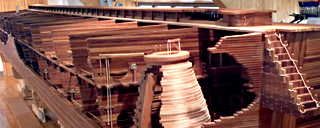
Noah's Ark Replica
Dramatic 25 Foot Detailed Replica
Biosphere Project
Re-creating What It Was Like Before Noah's Flood
5
Sep

Creation Devotional September 10 - Design

Daily Devotional – September 10

Design


A common illustration used in biology textbooks shows the forelimb of a bat, bird, dolphin, and human. These forearm bones have a similar design even though the specific parts are completely different in size, shape, and function. This comparison is known as “homologous structures.” It is taught that similar features of different organisms prove that they had a common ancestor. Advanced biology books state that the source of similar structures is the “common gene coding areas” in each embryo’s DNA coding. Yet, this was disproven over 30 years ago. We know that similar structures in different creatures come from completely different genes1 – meaning there is no scientific reason to believe that homologous structures are the result of common origin.


Even more dishonest is the selective use of “similar structures” to support the belief in evolution. The eye of a cephalopod (octopus) is FAR more similar to the human eyeball than the arm of a human is similar to the arm of a bat, bird, or dolphin. Yet nobody thinks there is any close ancestral relationship between an octopus and a human. Thus, quite dissimilar features (like the flipper of a dolphin and the arm of a human) ARE considered proof of evolution while almost exact similarities (like the eye of an octopus and that of a human) ARE NOT considered ancestral relationships. This smacks of a double standard.


The picking and choosing of which features to accept and which features to ignore is evidence that evolution is actually story-telling and not science. Similarity in features, which appear throughout the animal kingdom, is evidence of a common designer. God designed the best from the beginning and just continued using the same design when needed.


For my thoughts are not your thoughts, neither are your ways my ways, saith the Lord.

- Isaiah 55:8

5
Sep

Creation Devotional September 9 - Microbiology

Daily Devotional – September 9

Microbiology


There are billion-dollar hotels in Las Vegas because the owners know that they are going to make money from the majority of people coming through their doors. Statistics is science and assures us that certain things are either going to happen or not.


Statistics can also be used to prove that life could never have made itself. There are an estimated 1080 atoms in the entire universe. Even if our universe were 15 billion years old (1018 seconds) and each of these atoms are interacting with each other every trillionth of a second, this would only allow 10112 possible chemical interactions since the beginning of time. Let’s compare that number (10112) to the odds of the correct proteins and enzymes, needed for life, coming into existence by chance processes.


It is believed that the very simplest form of life would require at least 20 proteins and 387 enzymes – all with very specific sequences of amino acids.1 If the average sequence of these chemicals is 10 amino acids, the odds of these amino acid arrangements forming by random chance would be 20 raised to the 10th power raised to the 387th power. In other words, once in 105035 tries. This is absurdly less likely than the 10112 possible interactions of every atom in the history of the universe. Once in a trillion odds would be like flipping a coin and randomly getting heads 40 times in a row. No-one would ever believe this could happen. Once in 105035 is an inconceivable impossibility.


God has made it absolutely obvious; the molecules of life were designed by intelligence, not chance.


[I will do mighty wonders ] that they may see, and know, and consider, and understand together, that the hand of the Lord hath done this, that the Holy One of Israel hath created it.

~ Isaiah 41:20


Source: "Pearls in Paradise" by authors Bruce Malone and Jule Von Vett

References for this devotional.

5
Sep

Creation Devotional September 8 - Biology

Daily Devotional – September 8

Biology


Have you considered the tiger swallowtail butterfly? In order not to be eaten, it has three disguises it uses through its various stages to adulthood.


  1. The newly hatched larva looks like bird droppings. What bird would want to eat bird poop?! Three molts later, the caterpillar has turned green to match the leaves upon which it feeds.
  2. In addition, the head of the caterpillar’s green plump body has two large spots that resemble snake eyes. Birds that eat caterpillars hate snakes!
  3. Finally, in its pupa stage, the tiger swallowtail looks like a broken twig on a tree.


These three disguises reflect a great deal of knowledge about the behavior of the creature that wants to eat this butterfly.


  1. How did the larva grow itself to look like bird droppings? Did he look at droppings, know that birds don’t eat droppings, and decide to transform his body to look like that?
  2. At its third molt, how did it know to put the eyes of a snake on its green body? How did it know that birds are afraid of snakes? Had the caterpillar seen a snake?
  3. During its pupa stage, how did it figure out how to color itself with the color and shape of a broken twig?


Evolutionists believe that because these things give the tiger swallowtail a survival advantage, they all just happened over huge time periods by accident and chance. Does this really make sense? The tiger swallowtail is a master of disguises, but he was provided that by our loving Creator.


The LORD will preserve him and keep him alive...

~ Psalm 41:2a


Source: "Pearls in Paradise" by authors Bruce Malone and Jule Von Vett

References for this devotional.

5
Sep

Creation Devotional September 7 - Cosmology

Daily Devotional – September 7

Cosmology


Why would God make galaxies? We live in the Milky Way galaxy, which contains over 100 billion stars. Our galaxy is disk-shaped with a bulge in the middle. The Earth is located on one of the arms of this spiral galaxy. About 30 of our closest galaxies are grouped into a cluster called “The Local Group.” Another cluster is called the “Virgo cluster,” which has about 2,000 galaxies. Between these clusters of galaxies are voids. It is estimated that there are 100 billion galaxies. But why aren’t stars just randomly dispersed across the universe?


Galaxies have a special purpose. Galaxies are visible from greater distances than a single star could ever be. It is much easier to see a group of stars in a galaxy than one lone star! Take a piece of paper, and draw one star on it. Take another paper, and draw many stars on it. Now walk to the other side of the room. Which is easier to see, one star or a large group of stars? Galaxies allow us to understand the enormous size of the universe and the power of God in a way that single stars evenly dispersed around the universe could not. The heavens do declare the glory of God, but we could never know the vastness and the quantity of the stars in the universe if they were not grouped into galaxies.


Lift up your eyes on high, and behold who hath created these things, that bringeth out their host by number: he calleth them all by names by the greatness of his might, for that he is strong in power; not one faileth.

~ Isaiah 40:26


Source: "Pearls in Paradise" by authors Bruce Malone and Jule Von Vett

References for this devotional.

5
Sep

Creation Devotional September 6 - Biology

Daily Devotional – September 6

Biology


One of Australia’s more bizarre creatures is the thorny devil. It looks like a walking cactus with sharp spikes all over its body. In the desert, there is not much water, but during the cool nights, dew collects on the lizard’s spikes. Tiny grooves or channels between the spikes direct the condensed water to the thorny devil’s mouth - allowing him to quench his thirst. The water is not moved by a pump or gravity, but by capillary action. You can see capillary action by placing a straw into a glass of water. Notice that the water rises up into the straw above the level of water in the glass. The smaller the channel, the further up the water will flow. Once water is in the grooves, all the lizard needs to do is swallow - this action sucks the water to his mouth, which in turn causes more water to move along the grooves.


Not only can the thorny lizard capture moisture at night from dew, it can also remove moisture from the vegetation it moves through by rubbing his belly on wet rocks or kicking damp sand on his back. What a design! The system effectively and efficiently sucks water from all over his body. He uses this superpower to the hilt, like a walking sponge; the thorny devil gathers all the water he needs. It is hard to believe that this system of grooves came about by accident and chance through millions of years. This system of spikes and grooves needed to be present from the beginning in order for the lizard to survive in a desert environment. What an ingenious water-collecting system!


The beast of the field shall honour me, the dragons and the owls: because I give waters in the wilderness….

~ Isaiah 43:20


Source: "Pearls in Paradise" by authors Bruce Malone and Jule Von Vett

References for this devotional.

5
Sep

Creation Devotional September 5 - Paleontology

Daily Devotional – September 5

Paleontology


When Europeans first settled in Australia, they recorded Aboriginal stories of a creature called the bunyip. This huge creature lived in swamps and had a “blood-chilling cry.” In the 1800s, in Victoria, Australia, the bones of a bunyip were found. It was reported in the July 1845 edition of the Goolong Advertiser newspaper that an Aboriginal had identified this as a bunyip bone. He then drew a picture of the bunyip. This picture was taken to other Aborigines, who had no chance to communicate with the first one, and each identified the bone and picture as a bunyip. The newspaper reported a number of sightings of the bunyip; it looked like an alligator standing 12 feet tall. Its hind legs were thick and strong, with forelegs longer. It had long claws. It could swim. It walked on land with its hind legs and head erect. It was covered with multicolored scales and laid pale blue eggs double the size of an emu’s egg. Its snout was like a duck’s bill.


The description and newspaper sketch bear a strong resemblance to the duck-billed dinosaurs - 13 years before the first fossil duck-billed dinosaur bone was described. Dinosaurs and man did live together. Today, many dinosaurs have gone extinct. When we put on our biblical glasses, we would expect these types of widespread reports after the Flood as the dinosaurs left the ark and spread out and filled the Earth.


Every beast, every creeping thing, and every fowl, and whatsoever creepeth upon the earth, after their kinds, went forth out of the ark.

~ Genesis 8:19


Source: "Pearls in Paradise" by authors Bruce Malone and Jule Von Vett

References for this devotional.

5
Sep

Creation Devotional September 4 - Design

Daily Devotional – September 4

Design


If you listen closely, you will realize that birds are extremely skillful musicians. When birds sing, you can hear melody, harmony, and rhythm. Many birds sing in “absolute pitch”, that is, if they sing a song in G major today, the same song will be sung in EXACTLY the G major pitch all other days. There is also evidence that birds can transpose songs from one key to another. Male blackbirds have been observed to sing in matched counter-singing, i.e. each blackbird takes turns singing a tune back to other birds. Some birds even sing a variation on a theme. When human musicians attempt a matching counter-singing, it requires planning, talent, practice, and design.


Some birds sing duets; the African robin performs its duet antiphonally (where 2 birds sing alternate notes in a song). To execute this type of duet requires split second timing! When you hear a bird singing, notice that the songs contain consonsant intervals, which produce a pleasant sound, rather than dissonant intervals. Hermit thrushes have been found to sing the pentatonic scales. Other birds can sing two notes at the same time because of the position of their voice boxes.


Both Mozart and Beethoven recognized birds’ musical abilities and borrowed bird songs as inspiration for their music. Bird songs show evidence of structure and beauty. If evolution was true and songs evolved by accident or chance, then at least half the songs should be grating, irritating, and nonsensical. We do not hear that! The worldwide morning song of birds is known as the “Dawn Chorus” - welcoming in a new day. When we hear beautiful music, we know it has been composed and that there must be a composer. Bird songs are beautiful – take time to listen to what Jesus, the Greatest Composer of all, has composed for our pleasure.


Let everything that hath breath praise the LORD.

~ Psalm 150:6


Source: "Pearls in Paradise" by authors Bruce Malone and Jule Von Vett

References for this devotional.

5
Sep

Creation Devotional September 3 - Biology

Daily Devotional – September 3

Biology


There are over 245 different species of poison dart frogs that live in the rainforests of the Americas. They display a dizzying array of bright colors ranging from deep blue to strawberry red and metallic green to polka-dotted yellow! The golden poison dart frog is one of the deadliest; if a person has the equivalent of two grains of table salt of the toxin in his bloodstream, he is dead within minutes! This toxin is so powerful that if an animal even touches the spot where a golden poison dart frog has recently sat, it dies!


When indigenous Colombian natives go hunting, they will catch these golden poison dart frogs and rub their darts on the frog’s back. They then use blow guns with their poisonous darts to kill monkeys, birds, or even jaguars. One golden poison dart frog has enough poison to kill 10-12 people. Yet, the same frogs in captivity are not poisonous. Why?


Poison dart frogs obtain their poison from the foods they eat - such as ants and beetles. In captivity, they are not fed their usual rainforest food. How does a poisonous dart frog fit into the biblical account of a perfect, death-free world as described in the Garden of Eden? In the beginning, everything was good; dart frogs did not have an active poison. Adam and Eve could have held these dart frogs, examined their dazzlingly beautiful colors of red, blue, and yellow - and not been harmed. When Adam sinned, nature became cursed. Animals started to eat one another, and inactive defensive mechanisms became activated. Thus, the dart frogs became poisonous only after eating other creatures. God gave these tiny frogs protection from predators in a fallen world.


Our help is in the name of the Lord, who made heaven and earth.

~ Psalm 124:8


Source: "Pearls in Paradise" by authors Bruce Malone and Jule Von Vett

References for this devotional.

5
Sep

Creation Devotional September 2 - Biology

Daily Devotional – September 2

Biology


A United States entomologist has estimated that one pair of Colorado potato beetles, if allowed to reproduce unchecked, would increase to over 60 million in one season. One female fly, beginning reproduction in May, would produce 143,875 bushels of flies by August. Aphids reproduce quickly, and in one season they can produce over 13 generations. If not held in check, the world’s aphid population would be ten sextillion aphids in one year. Imagine living in a world where insects were not controlled. But what controls insect reproduction rates?


Fortunately, birds have a large appetite for insects. It has been found that a scarlet tanager can eat over 600 gypsy moth caterpillars in 18 minutes. It has been estimated that chickadees alone eat over 8 billion insects per year. Birds keep the insect population in balance. Now consider what evolutionists say about the origin of birds – they did not evolve until many millions of years after insects appeared on our planet!


Without birds, insects would have decimated the world’s vegetation. The world would have been a bleak place with little life. What we see is actually what God has said, that He created both birds and insects during the first week of creation at the very beginning of time.


As soon then as they were come to land, they saw a fire of coals there, and fish laid thereon, and bread.

~ John 21:9


Source: "Pearls in Paradise" by authors Bruce Malone and Jule Von Vett

References for this devotional.

5
Sep

Creation Devotional September 1 - Christian Truth

Daily Devotional – September 1

Christian Truth


Not everything we observe in our world has scientific explanations. The following is the testimony of a Nepal Christian as recorded by missionary Paul Michaels:


A teenager named Dal Bahadar had been cheating death for several years while traveling high into the Himalayan Mountains in search of yartsa gunbu treasure. He was young and strong - so why should he be afraid? On one trip, after searching and finding several days worth of the elusive worm-like parasitic fungus, he suddenly felt an oppressive weight come upon his legs and fell to the ground. For the next three days, the rest of his body felt quite normal while his legs continued to bear a weight that pinned him to the snow. Eventually, he realized that he was encountering a spiritual force. As soon as he bowed to his new lord, he was able to get up and travel back to his village. It was the beginning of being possessed with an evil spirit that chose to randomly empower Dal Bahadar to heal those who were sick. He became an influential “witchdoctor” fo rhis region.


Why he was chosen was as much a mystery as the powers that would unpredictably overcome him for the next seven years. Once these powers were newly manifested, his father-in-law sent him to a cave-dwelling Shaman to hone his powers. Some may think that possessing such power is a high calling, but Dal Bahadar found it to be a life of constant torment. He was continually sick and was trapped to serve his ruthless spiritual ruler. Possessing healing powers led others to revere him, but the physical and spiritual oppression drove his wife to find another man, and her abandonment only added to his torment.


Then one day a man from his village, Bhem, who had also been tormented with years of sickness, was made well by another healer. Everyone in the village was curious. How did this happen? Bhem told them, “A more powerful Ruler had healed him.” He had been told of the Redeemer-King, Jesus, and he believed in him. When Dal Bahadar heard this news, he begged Bhem to take him to this church in a village several hours away. He too wanted to be set free. As he attended the church each week, he heard the good news of God’s forgiveness comes through faith in His Son, Jesus Christ. On his fourth visit, he believed in Jesus Christ, and the church prayed for him. A peace he had never known before began to flood his soul.


Dal Bahadar has now been a believer for four years, leads a small fellowship of Christians in the village of Sayakhola, and is one of the students being trained for church planting in Mugu. Now his life’s goal is to bring the freedom that Jesus offers to every village in the province of Mugu over the next five years. His treasure hunt for a healing fungus high in the Himalayan Mountains ultimately led Dal Bahadar to a far greater treasure.


As for me, I will call upon God; and the Lord shall save me. Evening, and morning, and at noon, will I pray, and cry aloud: and he shall hear my voice.

~ Psalm 55:16-17


Source: "Pearls in Paradise" by authors Bruce Malone and Jule Von Vett

References for this devotional.

ABOUT THE MUSEUM
The Creation Evidence Museum
of Texas is a 501(c)3 non-profit
educational museum chartered
in Texas in 1984 for the purpose
of researching and displaying
scientific evidence for creation.
CONTACT INFO.

3102 FM 205
Glen Rose, Texas 76043
Phone: 254-897-3200

Map Pin   Location Map

HOURS

Thursday - Saturday
10am - 4pm

ADMISSION

$5 Per Person
FREE - Children 5 & Under

Creation Evidence Museum Building

Use & Privacy Policy  |  Site Map

All contents © 2013 Creation Evidence Museum of Texas. All rights reserved. Please note that any use of content downloaded or printed from this site is limited to
non-commercial personal or educational use, including "fair use" as defined by U.S. copyright laws.