











Creation Devotional January 6 - Cosmology
Daily Devotional - January 6
Cosmology
Under the inspiration of the Holy Spirit, Jeremiah compared the future descendants of Israel, “… as countless as the stars of the sky and as measureless as the sand on the seashore” (Jeremiah 33:22). Jeremiah was explaining that Jews would become so widely dispersed around the earth that no census could count them, just as all the stars in the universe or grains of sand upon the earth could never be counted. Yet in his day, all the visible stars could be counted. At that time, 600 B.C., early astronomers counted about 3,000 stars in the night sky. It was not until the 20th century that astronomy affirmed that the stars were indeed countless by humans.
The Hubble telescope captured a long time-lapsed image in a seemingly dark part of the universe near the Big Dipper. The area they photographed would be equivalent to our standing on earth and holding a grain of sand at arm’s length. When this image was compiled, this completely dark region was found to contain more than 10,000 galaxies, with each galaxy containing an estimated 100 billion stars (Hubble Ultra-Deep Field). Now imagine grains of sand covering the night sky and behind each grain being more than 10,000 galaxies, each containing 100 billion stars! What an immense number of stars. Truly the numbers of stars are as countless as the sands on the seashore! Our minds can hardly grasp the multitude of stars! Today it is estimated that there are roughly 1024 (10 followed by 24 zeros) stars. And the Jewish descendants are indeed scattered around the globe in numbers so large that no census can count them all. When God speaks on science, what he has to say is absolutely accurate. Should that be any surprise? After all, He’s the one who made science!
The heavens declare the Glory of God.
~ Psalm 19:1a
Source: "Pearls in Paradise" by authors Bruce Malone and Jule Von Vett
Creation Devotional January 5 - Biology
January 5
Biology
What ant-sized crustacean resembles a bright iridescent blue jewel but disappears in the blink of an eye? It is the sea sapphire, which lives in tropical and subtropical oceans around the world. This amazing creature can appear and disappear before our very eyes because of the cell structure on its back. A sea sapphire has microscopic layers of honeycomb-shaped crystal plates embedded in its skin cells. The crystal plates are all the same thickness, but the spacing between the stack of plates determines the wavelength of light (color) that is reflected back. The space between these plates is four ten-thousandths of a millimeter, about the same distance as a wavelength of blue light, so blue light is reflected back. If the angle of viewing changes to 45 degrees, the reflected light shifts from the visible light range to the invisible ultra-violet range, making it disappear before our very eyes. How intricate and precise! Our Creator loves to delight us with the smallest details - even beautiful, disappearing crustaceans aptly named sea sapphires.
And above the firmament that was over their heads was the likeness of a throne, as the appearance of a sapphire stone
~ Ezekiel 1:26
Source: "Pearls in Paradise" by authors Bruce Malone and Jule Von Vett
Creation Devotional January 4 - History
Daily Devotional - January 4
History
When we hear the word “cavemen,” we often think of primitive people wearing bear skin clothing and carrying wooden clubs. In fact, people have lived in caves throughout history; some even live in caves today. In the Yellow River region of China, some 20 million people are still living in caves. These caves are carved out of silty soil and are packed so hard that they do not need support. The caves usually measure 10 feet by 13 feet and extend 20 to 25 feet into the hillside. They are warm in the winter and cool during the hot summer. They have many modern comforts such as plumbing, electricity, and even cable television. Caves are a great place to live, to which 20 million Chinese can attest. Are these people primitive? Hardly! Based purely on evolutionary ideas, people assume that humans who lived in caves were primitive brutes. In chapter 10 of Genesis we find the account of the tower of Babel. As people migrated across the earth, some sought shelter in caves as they built more permanent homes. Today we often find their archeological remains in caves. Neanderthal man is one such example. The fact that they lived in caves did not make them primitive; it is just another housing choice.
Then he came there to a cave and lodged there…
~ 1 Kings 19:9
Source: "Pearls in Paradise" by authors Bruce Malone and Jule Von Vett
Creation Devotional January 3 - Geology
Daily Devotional - January 3
Geology
Imagine that you drive into a deserted town and happen to stop at a closed restaurant. You go around to the back of the building and peer in the window, and there on the kitchen counter is a stack of food-encrusted plates. By looking at the plates, you really cannot know how long they have been there nor can you know how much time passed between the placing of the first plate at the bottom of the stack and the plate located at the top of the stack. It could have been mere seconds from the placing of the first plate until the placing of the last plate. Or perhaps the stack was made on a weekend or the dishwasher had a day off and days passed between the placement of the plate at the bottom of the stack and the placement of the final plate at the top of the stack. The stack itself reveals nothing about the time frame – only that the bottom plate was deposited first and the top plate was deposited last.
In a similar way, the geologic layers of the earth, in no way, prove an enormous age for the earth. The sedimentary layers are very much like this stack of plates. They simply reveal which plates (layers) were laid down first during the worldwide flood of Noah and which plates (layers) were laid down during the final stages. The geological column is the record of what was laid down during the year-long Flood of Noah’s time, not how old the layers are.
The fear of the Lord is the beginning of knowledge, but fools despise wisdom and instruction.
~ Proverbs 1:7
Source: "Pearls in Paradise" by authors Bruce Malone and Jule Von Vett
Creation Devotional January 2 - Biology
Daily Devotional - January 2
Biology
Imagine an ant hill made out of pine needles seven feet high! That’s what you can find in Northern Europe and cold Siberia. These wood ants don’t build ant hills out of sand but collect massive amounts of pine needles and pile them on tree stumps. The rotting vegetation causes heat, providing warmth during the winter, and during the summer, the pine needle pile is full of holes and tunnels for ventilation and air conditioning. It is steep-sided to shed water. To prevent fungal or bacterial infections, the ants apply pine resin to their bodies as a disinfectant. These wood ants know what to do; they do it because of instinct. Instinct is what God has built into these wood ants, so they know how to build their pine needle nest, how to ventilate it and how not to get infections. All this is provided by a God who takes care of every detail. If He cares this much for a wood ant, how much more does He care for you?
(For after all these things do the Gentiles seek:) for your heavenly
Father knoweth that ye have need of all these things.
~ Matthew 6:32
Source: "Pearls in Paradise" by authors Bruce Malone and Jule Von Vett
Creation Devotional January 1 - Christian Truth
Daily Devotional - January 1
Christian Truth
We forget our past at peril to our future.
Almost every university in America was started as a Bible college in order to train future leaders in various areas of biblical knowledge. The central purpose of our centers of knowledge and training (universities) was to link knowledge to biblical truth. Yet today in many universities, morality has become relative, sin is no longer even acknowledged as real, there is no unifying source of truth, and the Bible is ignored or ridiculed. But God’s Word remains the foundation of all truth whether acknowledged or not. For instance:
• Almost all LAWS are based on some view of limiting “bad” behavior and enforcing “good” behavior. Yet with no basis outside of humanity to determine right from wrong (such as the Bible), the persuasive, powerful, or majority simply define right and wrong to suit themselves while laws become numerous, arbitrary, and twisted. Society deteriorates. That is exactly what is happening in America today.
• There are only two possible explanations for our existence – either distinctly different types of animals were created or simple organisms (such as bacteria) turned into more complicated things (such as people). Once the biblical account of life’s origins is rejected, much of BIOLOGY is simply misinterpreted.
• ECONOMICS is a biblical concept based on the stewardship of creation in order to develop the resources of the earth in a way that respects people as having been made in God’s image and pleases God. With the rejection of a Creator, economics has no ultimate purpose.
• Rejection of the reality of a Biblical world-covering flood means that most of GEOLOGY and the time frame of history get distorted and misinterpreted.
• Even the study of THEOLOGY becomes distorted. Theism acknowledges God as being ultimately in control (The Creator is God). Atheism assumes God does not exist, so the human intellect is supreme (I am God). Pantheism believes that creation itself is all that there is and therefore worships creation (Everything is God). Since a biblical God is left out of a students’ thinking throughout our public school system, the behavior of many students reflects some blend of atheism and pantheism. We ignore the foundational purpose of our universities (one truth) at peril to our future.
Professing themselves to be wise, they became fools.
~ Romans 1:22
Source: "Pearls in Paradise" by authors Bruce Malone and Jule Von Vett
Creation Lesson #10 - JESUS AND I …WHEN LIFE HURTS
Jesus Christ is the same yesterday, and to day, and forever (Heb. 13:8). He is the high and lofty One that inhabits eternity (Isa. 57:15). He upholds all things by the word of his power (Heb. 1:3). At this very moment Jesus, my Creator is…
- Thinking about me… “The Lord thinketh upon me” (Ps. 40:17)
- Guiding me… “I will guide thee with mine eye” (Ps. 32:8)
- Holding me… “Neither shall any man pluck them out of my hand” (John 10:28)
- Living within me… “I in them and thou in me” (John 17:23)
- Loving me… “Love them as thou hast loved me” (John 17:23)
- Cleansing me… “The blood of Jesus Christ his Son cleanseth us from all sin” (I John 1:7)
- Empowering me… “That I may know him, and the power of his resurrection, and the fellowship of his sufferings” (Phil. 3:10)
- Strengthening me…“Strengthened with might by his Spirit (Eph. 3:16), “My strength is made perfect in weakness” (II Cor. 12:9)
- Feeling my infirmities…“Touched with the feeling of our infirmities” (Heb. 4:15)
- Assuring me… “All things work together for good to them that love God, to them who are the called according to his purpose” (Romans 8:28).
“But God is faithful, who will not suffer you to be [tested] above that ye are able; but will with the [testing] also make a way to escape, that ye may be able to bear it” (I Cor. 10:13).
“Let us therefore come boldly unto the throne of grace, that we may obtain mercy, and find grace to help in time of need” (Hebrews 4: 16).
Creation Lesson #9 - Manipulation of Data, Haeckel’s Embryos
Introduction
Most of those involved in the Creation/Evolution conflict are aware of such outright frauds as the Piltdown Man of Sussex, England. From its discovery in 1912 by Charles Dawson until its factual public exposure in 1953, essentially the entire secular paleontology community accepted this fossil as an intermediate between Ape and Man. Over 500 doctoral dissertations were written on its technical place in the lineage of Man (designated Eoanthropus dawsoni, “Dawn Man”); and degrees were awarded from major universities around the world. One of the few scholars who saw through its fabrication early-on was the Oxford scholar Earnest Tolbert (Bull) Adams from Glen Rose, Texas. Upon seeing the famous fossil first-hand, he wrote home to his wife Mable that it was a fake. History later proved him to be correct. But the evolutionary community had accepted Piltdown and other dubious artifacts as concrete evidence to the point that evolution has now become so entrenched as to require no real evidence at all. Evolutionist and atheist Richard Dawkins famously announced: “We don’t need evidence [for evolution]. We know it to be true.”[1] There is a long list of “altered” or “manipulated” information, but Haeckel’s Embryos illustrate the point very well:
In his The Origin of Species (Chapter XIV), Darwin wrote that “the leading facts in embryology, which are seen as second to none in importance” should be considered “by far the strongest single class of facts in favor of” his hypothesis. Darwin was captivated by Haeckel’s drawings of select vertebrate classes, particularly the astounding similarity that he depicted among their early embryonic stages, and what Haeckel called “the biogenetic law” (or “recapitulation theory”). This simply means that embryonic growth of the fetus within the womb rapidly repeats the entire evolutionary history of the species prior to birth. But what we really see is -
I. MANIPULATIVE MIS-REPRESENTATION
Prior to Darwin’s The Origin of Species (1859), Europe’s famous embryologist, Karl Ernst von Baer (1792-1876), the discoverer of the tiny mammalian egg cell, had already disproved by careful empirical observation the evolutionary “law of parallelism” – the belief that embryos of “higher” organisms pass through the adult forms of “lower” organisms in the course of their development. Despite von Baer’s anti-evolutionary views, his evidence was manipulated by Haeckel and misrepresented by Darwin. According to Dr. Jonathan Wells “Von Baer lived long enough to object to Darwin’s misuse of his observations, and he was a strong critic of Darwinian evolution until his death in 1876. But Darwin persisted in citing him anyway, making him look like a supporter of the very doctrine of evolutionary parallelism he explicitly rejected.”[2]
II. PURPOSEFUL PROPAGANDA
“An embryologist, Dr. Michael Richardson [St. George’s Hospital Medical School], with the cooperation of biologists around the world, collected and photographed the types of embryos Haeckel supposedly drew. Dr. Richardson found that Haeckel’s drawings bore little resemblance to the embryos. Haeckel’s drawings could only have come from his imagination, which was harnessed to produce ‘evidence’ to promote the acceptance of evolution.”[3]
III. ILLEGITIMATE ILLUSTRATIONS
The astounding similarity between early stages of different vertebrate classes and orders that so captivated the interest of Charles Darwin is now known to be the result of Haeckel “doctoring” his drawings to make them all appear more alike than the actual evidence would allow. This is readily substantiated…
(a) Censored Samples: “Haeckel’s contemporaries repeatedly criticized him for these misrepresentations, and charges of fraud abounded in his lifetime…there is no doubt that his drawings misrepresent vertebrate embryos. First, he chose only those embryos that came closest to fitting his theory.”[4]
(b) Deliberate Deception: “Surprisingly, after developing quite differently in their early stages, vertebrate embryos become somewhat similar midway through development. It is this midway point that Haeckel chose as the ‘first’ stage for his drawings.”[5]
(c) Designed Distortions: “…the popularizers of evolution…still believe that similarities between embryos are evidence for evolution (common ancestry). But this confidence rests, consciously or unconsciously, on the woodcuts published by Haeckel and reproduced, in whole or in part, in many textbooks since. These drawings are widely believed to bear some resemblance to reality. But apparently no one has bothered to check.”[6] “In some cases, Haeckel used the same woodcut to print embryos that were supposedly from different classes.”[7]
(d) Erroneous Exaggeration: “Not only did Haeckel add or omit features…he also fudged the scale to exaggerate similarities among species, even when there were 10-fold differences in size.”[8] “Richardson and his colleagues also found that vertebrate embryos vary tremendously in size, from less than 1 millimeter to almost 10 millimeters, yet Haeckel portrayed them all as being the same size.”[9]
(e) Falsified Figures: “Finally, Richardson and his colleagues found considerable variation in the number of somites – repetitive blocks of cells on either side of the embryo’s developing backbone. Although Haeckel’s drawings show approximately the same number of somites in each class, actual embryos vary from 11 to more than 60.”[10]
YET THIS FALSIFIED INFORMATION IS STILL USED TODAY! “The Biogenetic law [Haeckel’s Drawings] has become so deeply rooted in biological thought that it cannot be weeded out in spite of its having been demonstrated to be wrong by numerous scholars.”[11]
[1] Richard Dawkins, Washington University Seminar: “Making Sense of Creation and Evolution.”
[2] Jonathan Wells, Icons of Evolution, 2000, p.86
[3] Ken Ham, Jonathan Sarfati, Carl Weiland, The Revised & Expanded Answers Book, 1900, p.120
[4] Jonathan Wells, Icons of Evolution, 2000, p. 91
[5] Ibid. p, 98
[6] Ham, Sarfati, and Weiland, op cit.
[7] Wells, op cit.
[8] Science, vol. 277, 9/5/97
[9] Wells, op cit, p. 92
[10] Wells, ibid.
[11] Walter J. Bock, Department of Biological Sciences, Colombia University, “Evolution by Orderly Law,” Science, vol. 164, May 9, 1969, pp. 684-5
Creation Lesson #8 - Creativity of Man, Mind of Man, Noah’s Ark, Gutenberg Press
Introduction
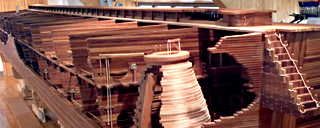
At the Creation Evidence Museum an entire section is dedicated to displays featuring the “Creativity of Man.” It begins with the construction of the 25-foot Replica by Dale Muska and his assistants; it continues with the creativity displayed in the engineering of the 1904 Oldsmobile, the artistry in the clay statue of coach Tom Landry by artist Robert Summers, the speech employed by Chief American Horse (featuring the actual attire he wore while negotiating peace between the Red Man and the White Man after the Battle of Little Big Horn), and the design in the space exploration instruments constructed by aerospace engineer Robert Helfinstine and his associates. These displays are actually in place at the museum. We should also mention the invention of the Gutenberg Press with movable type. The first book to be printed was the Gutenberg Bible! (The premier replicator of the Gutenberg Press is currently building a full-scale replica for our museum).
I. The Unparalleled Mind of Man
At the heart of the creativity of man is his awesome mind, designed to reflect the image of the Creator Himself. The human brain’s three pounds represent a mere two percent of the body weight…the quartful of brain is so metabolically active that it uses twenty percent of the oxygen we take in through our lungs…A third of our genes code for one or another aspect of the brain.”[1]
The brain allows the finger to feel vibrations of 8/1000 of an inch…Allows the eye to see 10 million different colors.[2] [T]he brain’s complexity is beyond anything [we had] imagined…the total number of synapses in a brain roughly equal the number of stars in 1,500 Milky Way galaxies![3] At the subconscious level “people can actually reason, anticipate consequences, and devise plans – all without knowing they are doing so.”[4] This introduces us to the power of the human mind and its amazing creativity.
Scientific American reports: “ [M]ounting evidence indicates that…a large mental gap separates us from our fellow creatures.”[5] “[O]ur species alone creates soufflés, computers, guns, make-up, plays, operas, sculptures, equations, laws and religion. Not only have bees and baboons never made a soufflé, they have never even contemplated the possibility.”[6]
The author lists various intriguing feats that animals accomplish and explains that “animal thoughts are largely anchored in sensory and perceptual experiences…We alone ponder the likes of unicorns, and aliens, nouns and verbs, infinity and God.”[7] The same article lists four unique ingredients of the human mind. (1) Generative computation enables humans to create a virtually limitless variety of words, concepts and things. (2) Promiscuous combination of ideas allows the mingling of different domains of knowledge – such as art,…space, causality and friendship – thereby generating new laws, social relationships and technologies. (3) Mental symbols encode sensory experiences both real and imagined, forming the basis of a rich and complex system of communication. (4) Abstract thought permits contemplation of things beyond what we can see, hear, taste or smell.”[8]
II. The Ark of Noah
Our 25-foot (1/20 scale) Replica of the Ark is the culmination of over forty years of research, months of working with our draftsman, eighteen months of actual craftsmanship on the vessel itself, and the sacrifice of dear people who contributed to make it possible. The original Ark was 300 cubits long, 50 cubits wide, and 30 cubits high[9]. The cubit is normally considered to be about 18 inches in length. Often the ”royal cubit” was given as up to 26 inches. Our research indicates that the cubit was very close to 20.5 inches. This would make the original Ark 500 feet long, 86 feet wide, and 52 feet high.
III. The Gutenberg Press
The art of printing originated in China. Emperor Ling of the Eastern Han dynasty inadvertently inspired this invention in AD 175 when he commanded that Confucian classics be engraved in stone. Bi Sheng invented a form of movable print during the reign of the Emperor Renzong of the Song dynasty, between AD 1041 and AD 1048. He took thin pieces of clay mixed with a sticky substance, carved a mirror image Chinese character on each piece and baked it in a kiln. When printing, he placed the characters in proper order on a coated metal plate.
Johannes Gutenberg (c.1395 – 1468) was a German blacksmith, goldsmith, printer, and publisher who introduced printing to Europe. His invention of mechanical movable type printing played a key role in the development of the Renaissance, Reformation, the Age of Enlightenment, and the Scientific Revolution and laid the material basis for the modern knowledge-based economy and the spread of learning to the masses. Gutenberg was the first European to use movable type printing, around 1439. Among his many contributions to printing are: the invention of a process for mass-producing movable type; the use of oil-based ink; and the use of a wooden printing press similar to the agricultural screw presses of the period. His truly epochal invention was the combination of these elements into a practical system which allowed the mass production of printed books. In Renaissance Europe, the arrival of mechanical movable type printing introduced the era of mass communication which permanently altered the structure of society.[10]
[1] Sherwin B. Nuland, op cit, p. 328
[2] Paul A. Bartz, Letting God Create Your Day (Minneapolis: Bible Science Association, 1993) Vol.4, p. 197
[3] E.A. Moore, Human Brain has more switches than all computers on Earth, CNET News, news.cnet.com November 17, 2010
[4] Joseph Weiss, “Unconscious Mental Functioning,” Scientific American, March 1990, p. 103
[5] Marc Hauser, “The Mind,” Scientific American, September 2009, p. 44
[6] Ibid.
[7] Ibid., p. 46
[8] Ibid.
[9] Genesis 6:15, The Holy Bible
[10] Google Information
Creation Lesson #7 - The Designed Human Mind
Introduction
The theory of Evolution envisions a physical and mental development of early man from primitive life forms. However, the documented facts tell a far different story. Man has been uniquely endowed by his Creator from his introduction on Day Six.
I. Superior Intellect from the Beginning
In the book, Panorama of Creation, this author has listed fifty-six characteristics that Pre-Flood man, from Adam forward, possessed.[1] As a society, only superior cultures have been documented as possessing all of these specific characteristics cumulatively. Among those fifty-six, ten are listed here:
- Conceptual Analysis: “And Adam gave names to all cattle, and to the fowl of the air, and to every beast of the field; but for Adam there was not found an help meet for him” (Genesis 2:20). The fact that specific names were given to all varieties of separate groups with emphasis on distinctions among them, requires the ability to conceptualize objectively. In order to determine that none of the individuals under consideration would be intimately compatible with the observer further enhances the evidence that the observer had mature self-awareness and mental acumen.
- Comparative Distinctions: “…gave names to all cattle…and to every beast of the field…” (Genesis 2:20). Distinction is made between groups; comparison and nomenclature are assigned accordingly.
- Synergistic Language: “And Adam said, this is now bone of my bones, and flesh of my flesh…” (Genesis 2:23, 24). Languages that feature enlarged expression, enhanced from preceding statements, require complicated emotional and mental capabilities.
- Poetic Declamation: “…bone of my bones…flesh of my flesh…called Woman (‘from man’)…taken out of man…leave his father and mother…cleave unto his wife…they shall be one flesh…” (Genesis 2:23, 24). This is first a form of complicated poetic expression; but it is also a progressive statement encompassing origin, state, and destiny of the speaking person (Adam) and the recipient (Eve) to be heard and observed by future generations (leave Father and Mother). Any concept of “evolving man” is totally incapable of explaining this speech form.
- Incident Reference: “…knew…conceived…have gotten a man…” (Genesis 4:1). A conscious reference is made to intimate physical relations, conception, and birth. Detailed sensitivities are honorably expressed with a deliberate emphasis on time and events.
- Religious Preoccupation: “…brought an offering unto the Lord…” (Genesis 4:3,4). Religious exercise is ascribed to sophisticated man alone. Here we observe conscious religious activity with a specific offering to a specific God.
- Moral Designation: “…whosoever slayeth Cain, vengeance shall be taken on him sevenfold…” (Genesis 4:15). Moral responsibility and consequences in the event of failure are clearly defined. Protection and restriction relating to the guilty party are also enforced.
- Offspring Endowment: “…and called the name of the city after the name of his son…” (Genesis 4:17). Filial endowments are recognized as being among the “ultimate resource and expression” of advanced Homo sapiens sapiens.
- Artistic Appreciation: “…all such as handle the harp and organ…” (Genesis 4:21). A “guild association” is implied within this statement. Such responsive appreciation in harmony with skillful dexterity would warrant applause from any historian looking back on this generation.
- Purposeful Motivation: “Thus did Noah; according to all that God commanded him, so did he…” (Genesis 6:22). Emphasis is placed on the words “all,” “commanded,” and “did.” Noah (and his family) had the physical, mental, and volitional capacity to follow purposeful instruction with conscious extended performance.
II. Abrupt Appearance of Intelligent Man
When history is properly interpreted, it has been demonstrated that Intelligent Man (comparable to Modern Man) appears fully functional, without intermediate fossils evolving from lower life forms: “There are no actual fossils directly antecedent to man.” ( L.B. Halstead, Nature, 20 Nov., 1980, p. 208). The major players in the “Ape to Man” myth have been re-examined and interpreted more correctly:
- Homo erectus and Homo sapiens… “H. erectus…is insufficiently distinct from H. sapiens. All fossil remains of H. erectus and archaic H. sapiens (including Neanderthals) should be reclassified into a single species, H. sapiens, which is to be subdivided only into races.” (New Scientist, “On the Origin of Races,” January 16, 1993)
- Neanderthal Comparison to Modern Humans… “Detailed comparisons of Neanderthal skeletal remains with those of modern humans have shown that there is nothing in Neanderthal anatomy that conclusively indicates locomotor, manipulative, intellectual or linguistic abilities inferior to those of modern humans.” (Erik Trinkaus, Natural History 87, 1978: 10)
- The Aurignacian People…Contemporaries with Neanderthal They lived in the Ach Valley of the Alb-Danube Region of Germany. A Star Chart of Orion1 was carved on a Mammoth tusk by these people who also lived as contemporaries with Job.
As Job’s consultants knew about the Creator and his association with mankind, these contemporary people would have the same general knowledge of the Creator and his splendors in the heavens.
1(www.spacetoday.org/SolSys/Earth/)
[1] Carl E. Baugh, Panorama of Creation, Bible Belt Publications, Bethany, OK, 1992, pp. 27-40

 Call 254-897-3200