






Location
 Contact Us
 
Creation Model
Noah's Ark
Hyperbaric Biosphere
Creation In Symphony Videos Now Online
Watch the entire video series on our YouTube Channel
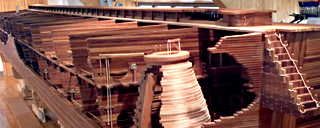
Noah's Ark Replica
Dramatic 25 Foot Detailed Replica
Biosphere Project
Re-creating What It Was Like Before Noah's Flood
20
Apr

Creation Devotional April 13 - Biology

Daily Devotional – April 13

Biology


What is the secret to an owl’s ability to rotate its head 270 degrees? Why are there not thousands of dead owls on the forest floor after having experienced a stroke from rapidly twisting their heads? Sudden head movements in humans--like whiplash--can cause the fragile blood vessel lining to stretch and tear, producing clots that break off, causing a deadly stroke.


Biologists have discovered many features allowing owls to turn their heads almost completely around. First of all, owls have 14 vertebrae in their necks whereas humans only have seven. In addition:

  1. The blood vessels at the base of the neck get larger as they get closer to the brain. This acts as a reservoir that continues feeding the brain when the twisting neck slows the blood supply.
  2. The owl’s neck bones have holes 10 times the diameter of the artery traveling through it. This extra space allows for greater flexibility and movement of the artery. In humans, the holes are the size of the artery.
  3. The vertebral artery enters the neck higher up than in other birds, creating slack, so the artery is not twisted shut as the neck turns.
  4. Owls have small vessels connecting both the carotid and neck bone arteries; humans do not. During neck rotation, if one of the vessels becomes blocked, the others can still let the blood flow uninterrupted.

All these unique features had to be there from the beginning; otherwise, the forest floor would be littered with dead owls. God uniquely created owls from the very beginning.


Who is so great a God as our God? Thou art the God that doest wonders:

~ Psalm 77:13b-14a


Source: "Pearls in Paradise" by authors Bruce Malone and Jule Von Vett

References for this devotional.

20
Apr

Creation Devotional April 12 - Biblical Accuracy

Daily Devotional – April 12

Biblical Accuracy


What if….you took 40 different people….from all different walks of life, social status, and vocations…living on three different continents…separated by thousands of years….writing in different moods (from sorrow to joy)… writing in three different languages….and writing about diverse topics. Would you expect to have a unified, harmonious story? Or would the result be a disjointed jumble of different ideas?


The Bible was written

  • By 40 different authors: shepherds, kings, soldiers, religious leaders, common men, statesmen, doctors, government officials
  • In different places: palaces, towns, large cities, deserts
  • At different times: times of war and peace, of prosperity and need
  • In different moods: joy and sorrow, fear and security
  • On three different continents: in Africa (Egypt), Europe (Italy), and Asia (Turkey)
  • In three different languages: Hebrew, Greek, Aramaic
  • About many topics: the nature of God, moral issues, religious ceremonies, history, science, documentation of facts
  • In multiple styles: poetry, songs, historical accounts, sermons, advice, personal letters, prophetic utterances, lineages, royal edicts, allegory
  • Over a 1500 year period


Yet, these 66 books share a common storyline - creation, fall, redemption - God’s love for us and His means of salvation to all who repent of their sins and follow Him with all their heart, soul and mind. This golden thread weaves its way throughout the Bible. It is the unified, harmonious story of God’s Word. In all 66 books, there are no historical errors or internal contradictions. The Bible is no ordinary book; it is the inspired Word of God!


All Scripture is given by inspiration of God…

~ 2 Timothy 3:16a


Source: "Pearls in Paradise" by authors Bruce Malone and Jule Von Vett

References for this devotional.

11
Apr

Creation Devotional April 11 - Biology

Daily Devotional – April 11

Biology


When an adult California ground squirrel discovers a rattlesnake lurking nearby, it often harasses it. In this area, baby ground squirrels make up 69% of the rattlesnakes’ diet. Therefore, the adult ground squirrel harasses the rattlesnake by dashing around it, nipping at its tail, kicking sand on it and waving his tail at it. The rattlesnake is not as fast or agile as the ground squirrel. If bitten, the ground squirrel doesn’t die because adult squirrels have proteins in their blood to neutralize the rattlesnake venom. Baby California ground squirrels, however, have not yet developed enough proteins to neutralize the poison. The ground squirrel will even taunt the rattlesnake by shunting extra blood to its tail, so it will heat up. Rattlesnakes can see heat (infra-red) and, therefore, lunges for the extra hot tail. Eventually the rattlesnake becomes frustrated and retreats. Interestingly, ground squirrels also harass gopher snakes – 50% of the gopher snakes’ diet also is baby ground squirrels. Gopher snakes, however, do not see heat, so the ground squirrel does not shunt extra blood to its tail when fighting with this kind of snake. How does a ground squirrel know that a rattlesnake can see heat and a gopher snake cannot? God knew the California ground squirrel would need this for its offspring’s defense, so He designed it to discern the difference.


O Lord, how manifold are thy works! in wisdom hast thou made them all: the earth is full of thy riches.

~ Psalm 104: 24


Source: "Pearls in Paradise" by authors Bruce Malone and Jule Von Vett

References for this devotional.

11
Apr

Creation Devotional April 10 - Design

Daily Devotional – April 10

Design


How many ways are there to fasten shoes? Old – fashioned shoes often had buttons; tennis shoes frequently use laces. Other shoes even use elastic or zippers. Some shoes, like children’s shoes and women’s sandals, often use Velcrotm. Where did mankind get the idea of creating Velcro?


One day in 1941, after going for a walk in the woods, Swiss electrical engineer George de Mestral noticed cockleburs stuck to both his pants and his dog. Instead of just cleaning them off, he decided to figure out what gave them their incredible sticking nature. He discovered they were designed with thousands of ingenious, flexible, barbed “fingers”, which allowed them to easily attach for a free ride on the fabric of clothing and hairs of an animal. So after eight years of research, Velcrotm, with its “hook and loop,” was invented. de Mestral used two strips of fabric, one with thousands of tiny hooks and another with thousands of tiny loops; de Mestral coined the term Velcro from the combination of the words “velvet” and “crochet.” The inventor observed the design that God had built into the cockleburs and came up with one of the most versatile and useful attachment systems ever developed! He was not the original designer; he just copied what THE Designer had already made!


O the depth of the riches both of the wisdom and knowledge of God!

~ Romans 11:33a


Source: "Pearls in Paradise" by authors Bruce Malone and Jule Von Vett

References for this devotional.

11
Apr

Creation Devotional April 9 - Microbiology

Daily Devotional – April 9

Microbiology


Do you realize that the evolutionary view of molecules-to-man can have a detrimental effect on scientific advancements? The latest example was the belief in “junk DNA.” For over twenty years, it was widely accepted that less than 2% of the coded information on the human DNA molecule was used to produce proteins (little molecular machines within the cell).1 Thus 98% of the human DNA sequence was assumed to be useless, leftover junk from our evolutionary past. This was accepted evolutionary dogma for many years, so scientists had no incentive to look for a purpose for this supposed “junk coding.” Thus, evolutionary preconceptions slowed scientific advancement in this area of genetics for decades.


Dr. Francis Collins (head of the Human Genome Project) stated in his book, The Language of God, that roughly 45% of the human genome is made of repetitive flotsam and jetsam and that this junk provides “compelling” evidence for the evolutionary origin of humanity. Yet, we can now conclusively show that essentially all the DNA’s coded sequence (including repetitive sections) serves multiple purposes and functions.


God doesn’t make junk, not even junk DNA!


Surely your turning of things upside down shall be esteemed as the potter’s clay: for shall the work say of him that made it, He made me not? or shall the thing framed say of him that framed it, He had no understanding?

~ Isaiah 29:16


Source: "Pearls in Paradise" by authors Bruce Malone and Jule Von Vett

References for this devotional.

11
Apr

Creation Devotional April 8 - Biology

Daily Devotional – April 8

Biology


Have you heard of the coywolf? Genetically it is ¼ wolf, 1/10 dog and the rest coyote. The coywolf is a hybrid twice the size of a coyote, able to hunt in both the woods (traditionally the place for olves) and on the prairies (traditionally the place for coyotes). With the help of the dog genetics, it is able to hunt in urban areas by eating rodents and pets or scavenging. If you spot one in suburbia, you will even notice that it may look both ways before crossing the street!


How did the coywolf come about? When the wolves of southern Canada experienced environmental problems of deforestation and drastic hunting, they began to interbreed with both coyotes and large breeds of domesticated dogs. The coywolf is not the result of evolution but the in-built diversity of genetic code that God has placed within the dog kind. It has also been  demonstrated that wolves, coyotes, and domestic dogs are the same kind since they can successfully interbreed.


And at evening let them return; and let them make a noise like a dog, and go round about the city. Let them wander up and down for meat, and grudge if they be not satisfied.

~ Psalm 59:14-15


Source: "Pearls in Paradise" by authors Bruce Malone and Jule Von Vett

References for this devotional.

11
Apr

Creation Devotional April 7 - Design

Daily Devotional – April 7

Design


Have you considered that the Sun provides the right amount of brightness on earth, and even on a cloudy day, there is still enough light? Why? Earth’s atmosphere makes this happen. When the Sun’s rays hit our atmosphere, they bounce off the air molecules, causing the light to scatter in all directions and lighting the sky. If we did not have our atmosphere, our sky would be pitch black - like the Moon’s. When the astronauts were on the Moon during the daylight, the sky was all black except when they looked right at the Sun. God has provided the right type of atmosphere so that when the Sun’s rays hit it, it provides the perfect amount of brightness…and a beautiful blue color.


Truly the light is sweet, and a pleasant thing it is for the eyes to behold the sun:

~ Ecclesiastes 11:7


Source: "Pearls in Paradise" by authors Bruce Malone and Jule Von Vett

References for this devotional.

11
Apr

Creation Devotional April 6 - Biology

Daily Devotional – April 6

Biology


Have you heard of a cave weta? This New Zealand insect lives in mountain top caves that can experience -10 oF during the winter. This insect actually freezes solid for three months - showing no brain activity or respiration. Then in the spring, it thaws out and proceeds with life as normal – doing whatever big bugs enjoy doing in the spring. They can go through six such freeze-thaw cycles in their lifetime, often living up to six years.


When humans freeze, crystals form in our blood, bursting our cells and causing our death. Wetas, however, have high levels of glucose, a sugar which keeps these crystals from forming. Evolutionists assume this all happened by accident and chance. What would have happened to the first weta that had not yet evolved a high enough sugar level in its blood? We’d have a dead weta! Evolutionary advancement would have ended, along with the first wetas! God had to design the cave weta to survive freezing from the beginning. Creation is shouting God’s glory!


O Lord my God, thou art very great;….

~ Psalm 104:1


Source: "Pearls in Paradise" by authors Bruce Malone and Jule Von Vett

References for this devotional.

11
Apr

Creation Devotional April 5 - Biology

Daily Devotional – April 5

Biology


Have you considered that birds like gannets and blue-footed boobies dive into the water at high speeds and do not break their necks! How do birds survive a dive like that? These birds come equipped with their own built-in “air bags”!


Gannets and blue-footed boobies like to go fishing. They flock together high in the sky, usually hovering over schools of herring, menhaden, or other fish. Then one of the gannets will single out a certain fish, tuck his wings close to his side and dive from heights of 100 feet. The gannet will slam into the water headfirst at 60 mph like a missile. What keeps his neck from breaking upon impact? Beneath the skin near the neck are air sacs that the bird fills by taking a gulp of air just before impact. This provides cushioning for the bird, just like the airbags in a car. Do we say that airbags started appearing in cars by chance? When we see an airbag, we know there must be an airbag designer. And who is the airbag designer in these birds? God our Creator. He designed the first airbags for the safety of birds like gannets.


For who in the heaven can be compared unto the Lord?...

~ Psalm 89:6


Source: "Pearls in Paradise" by authors Bruce Malone and Jule Von Vett

References for this devotional.

11
Apr

Creation Devotional April 4 - Biology

Daily Devotional – April 4

Biology


Termites are famous for eating wood, especially in houses. Yet, termites cannot digest wood. It is the microbes in the gut of the termite that break down the wood that allows it to be digested. The termites cannot exist without the gut microbes, and the gut microbes cannot exist without the termites; both need each other in order to survive.


Science calls this symbiosis or mutualism. Some scientists say this relationship evolved by accident and chance. Why would termites begin to eat wood if they could not digest it? Why would gut  microbes make their home in termite guts if they were not getting the food they needed? Both termites and gut microbes had to be together from the beginning, mutually depending on each other. Who would have thought that termites and their gut microbes give glory to God!


I will sing unto the Lord as long as I live:

I will sing praise to my God while I have my being.

~ Psalm 104:33


Source: "Pearls in Paradise" by authors Bruce Malone and Jule Von Vett

References for this devotional.

ABOUT THE MUSEUM
The Creation Evidence Museum
of Texas is a 501(c)3 non-profit
educational museum chartered
in Texas in 1984 for the purpose
of researching and displaying
scientific evidence for creation.
CONTACT INFO.

3102 FM 205
Glen Rose, Texas 76043
Phone: 254-897-3200

Map Pin   Location Map

HOURS

Thursday - Saturday
10am - 4pm

ADMISSION

$5 Per Person
FREE - Children 5 & Under

Creation Evidence Museum Building

Use & Privacy Policy  |  Site Map

All contents © 2013 Creation Evidence Museum of Texas. All rights reserved. Please note that any use of content downloaded or printed from this site is limited to
non-commercial personal or educational use, including "fair use" as defined by U.S. copyright laws.