






Location
 Contact Us
 
Creation Model
Noah's Ark
Hyperbaric Biosphere
Creation In Symphony Videos Now Online
Watch the entire video series on our YouTube Channel
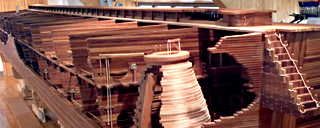
Noah's Ark Replica
Dramatic 25 Foot Detailed Replica
Biosphere Project
Re-creating What It Was Like Before Noah's Flood
18
May

Creation Devotional May 5 - Biology

Daily Devotional – May 5

Biology


The wombat is one of Australia’s many unique creatures that is found nowhere else on earth. This animal is a marsupial - meaning it has a pouch in which prematurely born young finish their development. Having a pouch is great if you are a kangaroo - but a wombat is a burrowing animal. If the pouch opened toward the mom’s head, the pouch would quickly fill with dirt. So the wombat’s pouch faces backwards; it opens towards the mother’s hind legs. Now, where did this unique animal come from? There are only two possibilities – creation or evolution. Either the wombat was created, fully formed and fully functional, or it evolved. Our schools teach, as a fact that something that wasn’t a wombat turned into the wombat. But how could this happen?


Evolutionists believe that the pouches of marsupials all started like the kangaroos, and through millions of years the wombat’s pouch “evolved” to face backward. Let’s try to imagine this process. First, you have a forward facing pouch in a creature that decides to burrow into the earth. Its pouch kept filling with dirt. Its babies kept dying. Then, one is born with a sideways facing pouch. Now, the baby can’t reach the milk glands. Its babies kept dying. Then finally, the pouch faces backwards! But millions of years would have passed, so how could this poor creature survive the slow process of evolving; many baby wombats would have died in the process. It is clear, God created the wombat’s pouch to be “backwards” from the very beginning.


Sing to the Lord, for He hath done excellent things; this is known in all the earth.

~ Isaiah 12: 5

18
May

Creation Devotional May 4 - History

Daily Devotional – May 4

History


Have you considered that the primary motivation leading to the development of the scientific method was the sinfulness of man! Sixteenth century Reformers acknowledged man’s depravity and therefore understood that even his ability to reason could not be trusted to determine truth. Because of man’s sinfulness, he has an inclination toward twisting things for his own purposes. So, science needed repeatable experimentation if its conclusions were to be accurate.


The Reformers also took seriously the command that man was to have dominion over creation, which meant he needed to study and understand it. These two ideas, man’s sinfulness and dominion, birthed the scientific revolution, which produced the founders of the various branches of science. These Bible-believing scientists included:


• Sir Isaac Newton - physics, optics, invention of calculus

• Joseph Lister - antiseptic surgery

• Johannes Kepler - celestial mechanics

• Louis Pasteur - bacteriology

• Michael Faraday - electromagnetism

• James Maxwell - electromagnetic equations

• Lord Kelvin - thermodynamics

• and MANY others


These men were “Thinking God’s thoughts after Him” to produce much of the technology we have today.


Sadly, much of “modern science” has returned to biased opinion over observation. As D.J. Kennedy has said in his book, What If Jesus Had Never Been Born, “It is interesting to note that science could not originate in the philosophical view prevalent in the world today. The prevailing philosophy of the Western world today is existentialism, which is irrational.”


We move away from true science, founded on the understanding that creation exists because we have a Creator, to our detriment!


And God blessed them, and God said unto them, Be fruitful, and multiply, and replenish the earth, and subdue it: and have dominion… over every living thing that moveth upon the earth.

~ Genesis 1:28


Source: "Pearls in Paradise" by authors Bruce Malone and Jule Von Vett

References for this devotional.

18
May

Creation Devotional May 3 - Geology

Daily Devotional – May 3

Geology


One of the most famous places to view petrified wood is at Specimen Ridge’s “Petrified Forest” in Yellowstone National Park. There, 63 rock layers contain vertical, petrified trees. It has been historically taught that a forest grew at each layer and were petrified in growth position—with each forest growing up and being buried by a volcanic eruption; then a new forest grew and was buried, and so on. For almost 100 years these layers were interpreted as having been laid down over hundreds of thousands of years. Yet, the facts point to a different explanation:


  1. Petrified tree rings from different layers were examined and found to match each other, indicating the petrified trees lived at the same time.
  2. Petrified trees did not have any root balls; they looked as if they were broken off abruptly.
  3. There were no true soils between any of the 63 layers, only debris that was undecayed. True soils would show gradations of decay.
  4. Mixed throughout the layers were tropical vegetation (brought in by the Flood waters.)
  5. Mineral content from the volcanic eruptions were the same. If each layer was buried under a different volcanic episode, the mineral content would be different. Yet throughout the layers, the mineral content was the same, indicating one super volcanic episode within a short period of time.


A better explanation would be a world-wide Flood. Trees were ripped by their roots and transported to this area. During the Flood they became waterlogged and sank vertically to the bottom of the water; eventually becoming covered with sediment. Yellowstone’s Petrified Forest testifies to the Flood during Noah’s time, not to huge periods of time upon the earth.


the same day were all the fountains of the great deep broken up, and the windows of heaven were opened. And the rain was upon the earth forty days and forty nights.

~ Genesis 7:11-12


Source: "Pearls in Paradise" by authors Bruce Malone and Jule Von Vett

References for this devotional.

18
May

Creation Devotional May 2 - Biology

Daily Devotional – May 2

Biology


What is faster than a speeding bullet, can break aquarium glass with a single punch, and draw blood from a human finger? A five-inch peacock mantis shrimp.


In the wild, peacock mantis shrimp eat foods such as clams, snails, and crabs - all of which have tough shells. With one swift knock-out punch, reaching the speed of a 22-caliber bullet, the shrimp shatters these shells and has a tasty lunch. How did the peacock mantis shrimp’s “club” become so powerful that it can even shatter aquarium glass? It’s all in the design.


The “club” has three layers. The outer layer is rich with minerals; the middle layer is composed of chitin with minerals dispersed within it; the inner layer has chitin fibers oriented in the opposite direction. The “club” is lightweight, stiff, tough, shock-resistant, and impact-tolerant. Today, researchers are studying the peacock mantis shrimp’s “club” in an effort to develop better body armor for soldiers. These scientists recognize a good “knock-out punch” when they see it! Let’s hope they also recognize the designer, Jesus Christ.


For the earth shall be filled with the knowledge of the glory of the Lord,...

~ Habakkuk 2:14


Source: "Pearls in Paradise" by authors Bruce Malone and Jule Von Vett

References for this devotional.

18
May

Creation Devotional May 1 - Christian Truth

Daily Devotional – May 1

Christian Truth


The Ten Best Evidences for a Young Earth as Confirmed in Science

  1. Very little sediment on the sea floor: Every year, sediment washes into the sea. At current rates, oceans contain about 12 million years-worth of sediment, not billions. Even this sediment exists because of erosion at the end of the Flood – not from 12 million years of slow accumulation. So, where are the billions of years of dirt, if earth is billions of years old?
  2. Bent rock layers: Throughout the world, we see sedimentary layers bent and folded without fracturing. This means they had to be bent when freshly laid.
  3. Soft tissue in dinosaur bones: It would be long gone in millions of years.
  4. Faint sun paradox: The sun gets its energy from the fusion of hydrogen into helium, deep within the sun’s core. As the hydrogen fuses, the sun’s core increases in temperature. This means billions of years ago, the sun was fainter or cooler. Only 3.5 billion years ago the entire earth would have been well below freezing - at a time when life supposedly evolved.
  5. Rapidly decaying magnetic field: The earth’s magnetic field is decaying so rapidly it could not be older than 20,000 years old.
  6. Helium in radioactive rocks: Helium is released during the radioactive decay of uranium and thorium contained in rocks. All the helium should have leaked out of the rocks in less than 100,000 years. So why are these rocks still filled with significant concentrations of helium?
  7. Carbon-14 found in fossils, diamonds and coal: C14 or radiocarbon decays quickly, so after a few hundred thousand years, no carbon-14 should be left, yet we find it in “ancient” fossils, diamonds, and coal.
  8. Short-lived comets: Every time a comet passes by the sun, it loses some of its mass. Given the observed loss rates, it is easy to compute the age of comets; the maximum age is well below billions of years.
  9. Very little salt in the sea: Every year salt gets transported into the sea from the continents. If the world’s oceans have been around for three billion years (as evolutionists believe), we should see almost 100 times more salt within ocean waters than we do today.
  10. DNA in “ancient” bacteria: Bacteria, believed by evolutionists to be 250 million years old, still had DNA. This is impossible unless they were quite recently buried. Also, they were shocked to find the bacteria’s DNA was very similar to modern bacterial DNA. Where’s the evolution?


Whatsoever the Lord pleased, that did he in heaven, and in earth, in the seas, and all deep places.

~ Psalm 135:6


Source: "Pearls in Paradise" by authors Bruce Malone and Jule Von Vett

References for this devotional.

20
Apr

Creation Devotional April 30 - Botany

Daily Devotional – April 30

Botany


In the jungles of Borneo, a bat looks for a daytime place to roost. He sends out his sonar throughout the crowded jungle and finds the perfect place echoing back, a pitcher plant. Amazingly, sonic reflectors grow right above the pitcher plants opening, bouncing back the bat’s own sonar. These sonic reflectors have tiny ridges, correctly spaced for just the right reflection. So the bat quickly finds a cool, parasite-free place in the hot rainforest to roost. But what benefit is there for the pitcher plant? It gets the bat’s droppings.


Bat droppings are extremely high in nitrogen, which the plant needs. As a matter of fact, dried bat guano (droppings) is collected from caves around the world for use as fertilizer. Many pitcher plants eat insects, but not this one; it dines on the nutrients in bat waste. This mutualistic, beneficial behavior is in the category of “wacky but wonderful.” Evolutionists believe that this pitcher plant (Nepenthes hemsleyana) was not good at attracting insects, so, it evolved a sonic reflector over millions of years in order to attract a different source of nitrogen (bat droppings). Does this make any sense at all? If a pitcher plant does not get enough nitrogen in the beginning, which is why it eats insects, wouldn’t it just die? How could it change its DNA to make the exact reflector it needed? How did a plant know that a bat sent out sonar? How did a plant know that bat droppings had the nitrogen it needed? This unusual partnership was set up by God; it did not happen by accident and chance.

the excellency of knowledge is, that wisdom giveth life to them that have it. Consider the work of God…

~ Ecclesiastes 7:12b, 13


“We can complain because rose bushes have thorns, or rejoice because thorn bushes have roses.”

~ Abraham Lincoln (1809 – 1865), 16th President of the United States


“Consider the lilies of the field, how they grow, they toil not, neither do they spin: and yet I say unto you, that even Solomon in all his glory was not arrayed like one of these… seek ye first the kingdom of God, and his righteousness; and all these things shall be added unto you.”

~ Matthew 6:28-29, 33


Source: "Pearls in Paradise" by authors Bruce Malone and Jule Von Vett

References for this devotional.

20
Apr

Creation Devotional April 29 - Geology

Daily Devotional – April 29

Geology


Water and wind gaps are common geological features found worldwide, yet their formation is a mystery to many scientists. These gaps form a shallow notch in the upper part of a mountain ridge. The notch is an erosional notch and is not caused from faulting (rock layer movements). Water gaps channels still have rivers running between the mountain peaks while wind gaps only have wind.


In central Wyoming, the Sweetwater River flows through such a granite ridge. How did the river cut this 330 feet deep channel? And what about the Arun River in the Himalayan Mountains flows through a water gap that is 4 miles deep and 13 miles wide. Why wouldn’t the water have flowed around rather than through these mountains? How does a river cut right through the top of a mountain ridge? It can’t! But if you put on your biblical glasses and view these gaps with the Genesis Flood in mind, the explanation becomes obvious. At the end of the Flood, as the continents and mountains of the world were rising up out of the water, enormous sheets of water would have been channelized, initially cutting a notch through the layers. As it continued to pour through the rising land surfaces, huge gaps were formed. Later, a river might run through the gap; scientists call that a water gap. If no river flows through but only wind, scientists call it a wind gap. We find these water and wind gaps all over the world… but of course we would. The Flood was a powerful, globe-covering event.


And the waters receded continually from the earth. At the end of the hundred and fifty days the waters decreased.

~ Genesis 8:3


Source: "Pearls in Paradise" by authors Bruce Malone and Jule Von Vett

References for this devotional.

20
Apr

Creation Devotional April 28 - Microbiology

Daily Devotional – April 28

Microbiology


For centuries, barnacles--crustaceans that live inside their exoskeletons--have frustrated ship owners because they like to glue themselves to ship hulls. It is difficult to remove them because their glue is so tenacious. But how does a barnacle’s glue stick to a wet surface?


There are two steps needed for a barnacle to adhere itself to an underwater surface: first it needs to clear the water away, and then it cements itself to the surface. The barnacle larva, which is the active swimming stage of a barnacle, releases an oily droplet to clear the water from the surface to which it wants to stick itself. Then, the larva releases a phosphoprotein adhesive. In essence, a super-glue!


Scientists are studying this two-step process in hope of being able to manufacture the glue for surgical use. We make great claims on how scientifically smart we are, but we can always improve our science by having a better understanding of how God made the identical thing in nature. Who knows, the next time you have surgery, “barnacle superglue” may be used!


The Lord is my strength and my shield; my heart trusted in him, and I am helped….

~ Psalm 28:7


Source: "Pearls in Paradise" by authors Bruce Malone and Jule Von Vett

References for this devotional.

20
Apr

Creation Devotional April 27 - Cosmology

Daily Devotional – April 27

Cosmology


Why isn’t the earth and all life on it, fried from deadly solar radiation? The earth is protected by a magnetic force field that surrounds it. Scientists are finding, however, that this protective force field is slowly wearing down (or decaying). At the current rate of decay, the magnetic force field can be no more than 20,000 years old. This means the Earth could not be older than 20,000 years.


Measuring the strength of the earth’s magnetic field began in 1845. Since that time, there have been many studies. One study showed the decay rate of 5% per century. Another study done by archeologists estimated that the earth’s magnetic field must have been 40% stronger in 1000 A.D. A more recent study from 1970 - 2000 by the International Geomagnetic Reference Field measured a loss of 1.4% in the magnetic field in just 30 years! This has far more profound implications than global climate change, yet it is largely ignored.


For the earth to be billions of years old, as evolutionists say, the earth’s magnetic field would long ago have disappeared, and we would have been bombarded by deadly solar radiation. But earth still has a force field surrounding it. When we do the math, it all points to a young earth and magnetic field. According to Scripture, the earth and the entire universe is only about 6,000 years old. Earth’s magnetic field shouts a young earth!


To him that by wisdom made the heavens: for his mercy endureth forever. To him that stretched out the earth above the waters….

~ Psalm 136:5,6


Source: "Pearls in Paradise" by authors Bruce Malone and Jule Von Vett

References for this devotional.

20
Apr

Creation Devotional April 26 - Biblical Accuracy

Daily Devotional – April 26

Biblical Accuracy


One criterion for determining the reliability of any ancient manuscript is the time which elapsed from the original manuscript to its later copies; the more time that has passed between the original and the copy, the more chance for errors to develop.


So what have manuscript studies found when comparing ancient documents? Caesar’s War Commentaries were written about 50 B.C.; we do not have the original. The only copies date from the 9th century - a 900 year gap! Aristotle’s works have a 1450 year gap. Plato’s works have a 1,250 year gap. Tacitus’s writings have a 1,000 year gap from the original manuscript, and Virgil’s works have a 300 year gap.


Now, let’s compare these ancient manuscripts (whose authenticity is not questioned) with the New Testament. Major copies of every book in the New Testament are within 100 years of the original. What a short time span! The closer to the original, the more accurate it will be. If the New Testament were a collection of secular writings, their authenticity would be beyond ANY REASONABLEDOUBT. The New Testament stands in a league of its own, far more trustworthy than any other ancient writing!


The grass withereth, the flower fadeth:  but the word of our God shall stand for ever.

~ Isaiah 40:8


Source: "Pearls in Paradise" by authors Bruce Malone and Jule Von Vett

References for this devotional.

ABOUT THE MUSEUM
The Creation Evidence Museum
of Texas is a 501(c)3 non-profit
educational museum chartered
in Texas in 1984 for the purpose
of researching and displaying
scientific evidence for creation.
CONTACT INFO.

3102 FM 205
Glen Rose, Texas 76043
Phone: 254-897-3200

Map Pin   Location Map

HOURS

Thursday - Saturday
10am - 4pm

ADMISSION

$5 Per Person
FREE - Children 5 & Under

Creation Evidence Museum Building

Use & Privacy Policy  |  Site Map

All contents © 2013 Creation Evidence Museum of Texas. All rights reserved. Please note that any use of content downloaded or printed from this site is limited to
non-commercial personal or educational use, including "fair use" as defined by U.S. copyright laws.